Google launches temporary threads in AI Mode in Search, conversations that are not saved to history
IA en un minuto newsroom · Editor: Jon Elgezabal
In 30 seconds
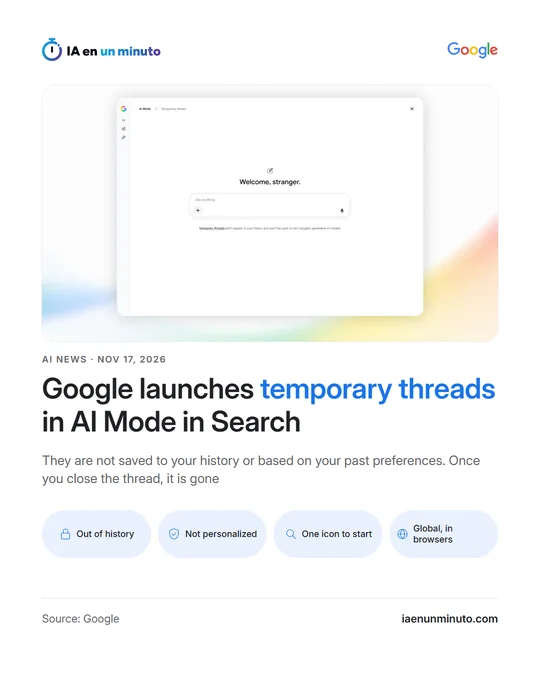
Google is adding temporary threads to AI Mode: chats that stay out of the history, ignore the user's past tastes and leave future recommendations untouched. AI Mode shows them through an icon in the top right corner, and closing one makes the conversation vanish. Google is bringing them to every country, to computer and phone browsers and to each language AI Mode handles.
Google has presented temporary threads in AI Mode, the AI mode of its search engine, according to an announcement on its blog. They are conversations that are not stored in the history, do not take the user's earlier preferences into account and have no effect on later personalization.
No setting has to be changed to use them: the user just taps the temporary threads icon at the top right of AI Mode and starts asking. Google says the session is kept fully apart from the user's account, and when the thread is closed it disappears and searching goes back to normal.
The company gives as examples looking for ideas for a surprise present or checking something the user does not want to see again later in the history or in recommendations.
The feature is being rolled out worldwide, in desktop and mobile browsers, and in every language AI Mode supports. The announcement does not mention Google's mobile apps.
Why it matters · analysis and opinion
In the normal mode, what someone asks AI Mode can weigh on personalization and resurface later in the history or in recommendations. With this mode, Google gives users a quick way out without forcing them to touch their account settings, just as the search engine converses more and keeps more context. It should not be confused with anonymity: the announcement talks about history and personalization, not about what data Google keeps from those sessions or for how long. For anyone using the search engine on a shared computer, at home or at the office, it is handy for one-off queries; with truly sensitive information, the prudent thing is still not to type it.
Official source: Google · Written with the help of AI: how we make the news