Switzerland confirms five cyberattacks with AI agents, four successful
IA en un minuto newsroom · Editor: Jon Elgezabal
In 30 seconds
BACS is now counting real intrusions that relied on AI agents, and most of them managed to get inside. Victims include operators of critical infrastructure and small firms, although no large-scale outages are on record and the culprits are unknown. The office expects further episodes and advises patching what matters urgently, while cutting back whatever can be reached over the network.
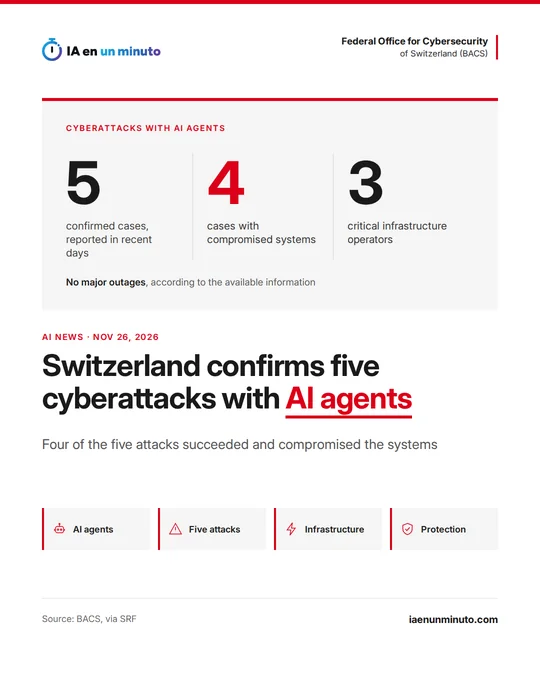
Five attacks carried out with AI agents, software given some freedom to complete tasks, have been confirmed by Switzerland's Federal Office for Cybersecurity (BACS), all of them reported over the past few days. Intruders broke in on four occasions, the office's director, Florian Schütz, told public broadcaster SRF.
Three of the victims run critical infrastructure, a label that takes in electricity, water or telecoms suppliers, to give some examples; SRF does not say which of those fields the three belong to. Smaller businesses that came forward voluntarily were breached as well. Nothing led to major disruption, BACS is withholding the names of the organisations, and who is responsible remains unknown.
According to the office, the stock of AI tools usable for such offensives has almost doubled since October, and more cases are expected. Its advice: apply critical updates as early as possible, within 24 hours of release at the latest, and keep the number of internet-facing systems to a minimum.
In the same report, specialist Raphael Reischuk, co-founder of Switzerland's national cybersecurity testing institute, predicts a bigger wave and warns that many small companies lack the means to keep their machines current.
Why it matters · analysis and opinion
What carries weight here is that the intrusions are now measured in verified cases instead of hypotheticals. They also reach essential services and modest businesses alike, so size offers no shield. Automated hunting for known flaws mainly punishes whoever is slow to update. For a company without an in-house team, the useful step is to agree in writing who installs urgent patches, weekends included, and to switch off or restrict remote access that nobody uses. Still unknown are which agents were used, how they got in and who was directing them, details that would help sharpen defences.
Source: SRF · Written with the help of AI: how we make the news
What does it mean for your business? · analysis and opinion
The warning comes from Switzerland, but the risk does not stay there: any small business, freelancer or small company in Spain or Latin America with services open to the internet (the website, email, remote access, the online store) can be within reach of automated tools like the ones described by BACS. The confirmed cases affected companies and not only critical infrastructure operators, and the agency has not said who is behind the attacks, so it is not wise to think that only large companies are of interest.
Our advice is to start with the basics, which are also the cheapest: changing the factory passwords on the router, the cameras or the website administration panel, turning on two-step verification wherever possible, and installing pending updates for programs and equipment connected to the internet. It also helps to make a simple list of what is accessible from outside and to close off what is no longer used.
It is also worth testing defences from time to time. For a small company, the sensible approach is to set a review at regular intervals, even if it is just a basic vulnerability scan, and to keep backups outside the main network. These measures cost little compared with a compromised system, which can mean days unable to work and problems with customer data.