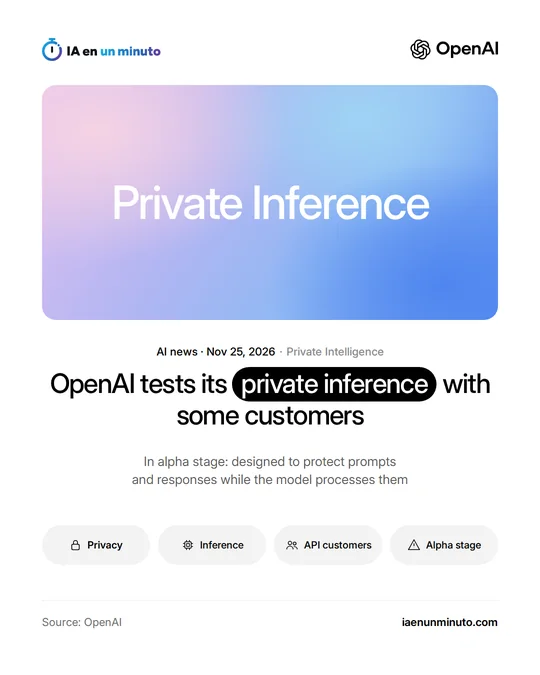
OpenAI tests Private Inference, its alpha-stage private inference feature, with a limited group of API customers
IA en un minuto newsroom · Editor: Jon Elgezabal
In 30 seconds
OpenAI has begun trying Private Inference with a few users of its API, as an alpha for now. Altman reported the move on November 25: the aim is to guard queries and answers right when the model handles them, relying on confidential computing. DevDay had already flagged it, while prices, supported models and the effect on latency remain unknown.
A small set of OpenAI customers is now trying out Private Inference, a feature built to shield both what people ask the AI and what it replies for as long as the model is working on it. On its Private Intelligence page, the company labels it an alpha.
Chief executive Sam Altman made the trial public on X on November 25 and asked interested organizations to get in touch. Unite.AI also reports that Shekar, the contact Altman pointed to, said OpenAI is securing confidential computing capacity for a far broader rollout.
Inference is the step where a model reads a query and produces its answer. To cover it, OpenAI says it brings together confidential computing, a technique that protects data while it is being used, and strict controls.
There had been an early notice. The company's official DevDay recap, from the developer conference held on September 29, announced a preview for this fall with verifiable controls, as one piece of Private Intelligence, its privacy offering for businesses.
According to DiarioBitcoin, access is limited to selected API customers, and supported models, latency impact and pricing have not been published yet.
Why it matters · analysis and opinion
Until now, much of the privacy debate has revolved around what gets stored and who can look at it afterwards. This feature moves attention to the moment of computation, where a clinic, a bank or a law firm may hesitate before using artificial intelligence on real files. A closed alpha, though, is no basis for production plans: access terms are missing and it remains to be seen how the guarantees will be checked from outside. Anyone working with delicate paperwork can start preparing concrete questions for their vendor: what can be audited, who controls the keys and what happens to information that triggers a safety review.
Official source: OpenAI · Written with the help of AI: how we make the news