AWS CEO Argues for Tighter Permissions on AI Agents
IA en un minuto newsroom · Editor: Jon Elgezabal
In 30 seconds
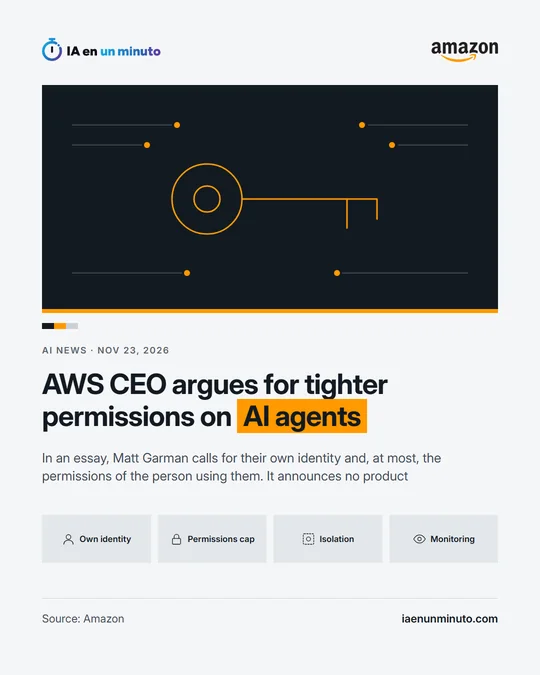
For Matt Garman, who runs AWS, protection against AI has to live in how systems are designed, not in a last-resort stop button. The essay asks for every agent to carry an identity of its own, with permissions that never exceed those of its user, and for the infrastructure to enforce them. He gives Firecracker and Nitro, two AWS technologies, as examples, and unveils nothing new.
Matt Garman, head of Amazon Web Services (AWS), released an essay on Amazon's news website on Monday, November 23, built around one central idea: keeping artificial intelligence safe should not be left to an emergency brake but to good engineering. He compares it to a car, where nobody counts on the handbrake to stay safe, but on brakes, steering and suspension designed to work together.
According to Garman, the tools for building reliable AI systems are already available. Principles that computer security has relied on for decades, such as identity, least privilege, activity logging and containment limits, work for AI too; what is missing, he argues, is for the industry to put time and resources into applying them. He describes today's models as optimizers: they act without ill intent, but if the limits leave a gap, they end up finding it.
The first point is identity. AI agents (programs that act on their own on someone's behalf) fit neither of the two classic categories, people and machines, so he calls for a separate kind of identity for them. At the very most they should hold the same permissions as whoever runs them, and often far fewer. That control has to come from the infrastructure, not from the agent's own reasoning, and everything it does must be recorded.
The second is isolation, which the essay says has to be stronger than whatever it holds in. Ordinary containers share the system kernel with the machine hosting them and were never designed as a security barrier. As an alternative he points to Firecracker, AWS's lightweight virtual machine technology, which keeps each workload apart at the hardware level and which, he says, the company tests against the most capable models.
The third is monitoring, which must not depend on the agent being watched: the data about what it does has to come from the infrastructure, not from the model. The example here is Nitro, the specialized hardware that runs all of AWS's infrastructure and keeps security functions apart from general computing.
For some uses he adds automated reasoning, a set of mathematical techniques that can prove what a model is able to reach and what it is not. None of these layers is enough by itself, he warns.
It is a position, not a rule: the essay announces no product and no specific measure. Garman says AWS will say more about it at its re:Invent conference, running from November 30 to December 4.
Why it matters · analysis and opinion
When the top executive at AWS talks about accounts, permissions and logs rather than smarter models, AI safety moves onto ground any IT department already knows. The text also has a commercial reading: Firecracker and Nitro are in-house technology and the essay lands a few days before re:Invent, so this is a vendor's position. Even so, its recommendations hold with any provider. Before giving an agent access to email, the business management software or the company website, it is worth checking which account it signs in with, whether it can do more than the person using it and where each step it takes is recorded. If nobody can answer, there is work to do before switching it on.
Official source: Amazon · Written with the help of AI: how we make the news