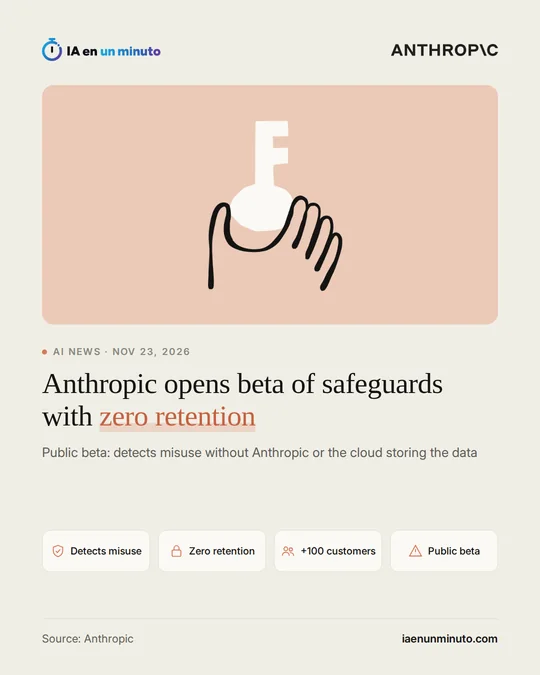
Anthropic opens public beta of its enterprise safeguards compatible with zero data retention
IA en un minuto newsroom · Editor: Jon Elgezabal
In 30 seconds
Enterprise Frontier Safeguards (EFS) moves into public beta for Anthropic's eligible customers. The automated monitoring hunts for abuse scattered across many queries, something per-request filtering misses, and does so on data the company keeps in its own cloud. Bridgewater, Salesforce and Stripe already used it privately, and Microsoft Foundry will join soon.
Anthropic wants to catch misuse of Claude without holding on to the data of the businesses that use it.
As of today, November 23, eligible companies can try Enterprise Frontier Safeguards (EFS) in public beta. It is a system for uncovering sophisticated abuse that works with zero data retention: neither Anthropic nor the cloud provider keeps a copy of what a company sends to the model. Anthropic has been refining it with more than 100 customers, among them a quarter of the Fortune 100, as well as many firms in sectors with tight rules on who may see data, such as healthcare, finance and law. Bridgewater, Salesforce and Stripe were already testing it in private beta.
Until now, customers on zero retention only had classifiers that check each request on its own. The problem, according to Anthropic, is that elaborate attacks are spread over many queries that look innocuous one by one. A report by the company recounts an attack on roughly fifty organizations where one AI agent handed out pieces of the job to many other agents working in parallel; seen one request at a time, it would have passed for a handful of loose, more harmless tasks. That is why EFS adds a second layer, automated safety monitoring, which tracks abuse patterns over many requests.
What matters is where the data ends up. The company supplies its own storage (Amazon S3 or Google Cloud Storage, in its own account), inputs and outputs are deleted as soon as they are written there, and the monitoring analyzes them without staff from Anthropic or the cloud provider getting access. Nor are they used to train models. When it spots a risk, the system opens a "Safety Case" for the company to review, and that case holds no inputs or outputs. The cloud provider bills for the storage as usual.
EFS can be used through Amazon Bedrock, Claude on Google Cloud, the Claude Platform and Claude Platform on AWS; Microsoft Foundry support will follow soon. Anthropic will contact eligible customers with instructions to get started. It has not given a separate price for the service or spelled out what it takes to qualify.
Why it matters · analysis and opinion
Until now, anyone who required that nobody keep their data had to settle for weaker protection: filters that judge each request without seeing the whole picture. EFS breaks that trade-off, and that matters most in banking, insurance, law firms or healthcare, where zero retention is not negotiable. The cost is operational: the company looks after the storage, pays whatever it costs in its cloud and has to review the cases the system raises, so it needs someone from security keeping an eye on them. Who counts as eligible and what the service costs are still unclear. For an organization already working with Claude on AWS or Google Cloud, the sensible move is to prepare its own storage and pick a narrow use case for when Anthropic gets in touch.
Official source: Anthropic · Written with the help of AI: how we make the news