IA en un minutoNewsBusiness and products
The New York Times Asks Freelance Photographers Not to Use Photoshop 2027 Over Its AI Features
IA en un minuto newsroom · Editor: Jon Elgezabal
In 30 seconds
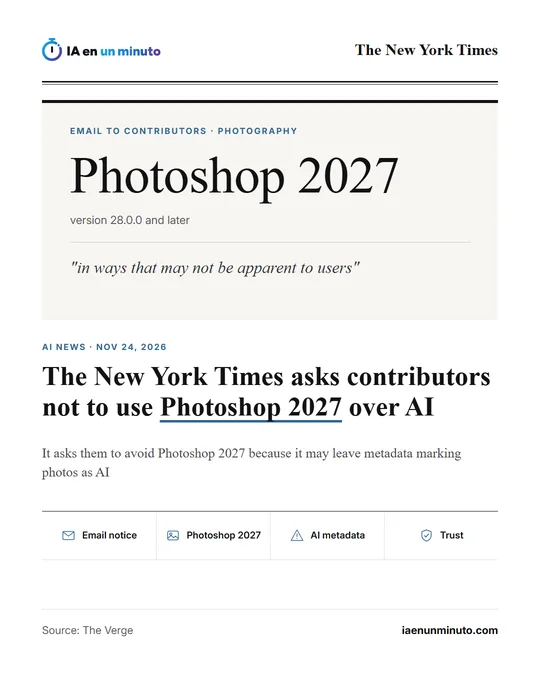
Photoshop 2027 is off limits, for now, when outside professionals shoot for The New York Times. Meaghan Looram and Josh Haner, who help lead photography there, fear the program's AI may act unnoticed and leave labels flagging pictures as generated. Graham James has stood by the decision to The Verge, though nobody has said which tools are the worry.
For the time being, The New York Times has ruled out the newest version of Photoshop, Adobe's image editor, on assignments that its freelance photographers carry out for the paper. The Verge, which saw the email and reported it on Tuesday, November 24, says it was signed by Meaghan Looram and Josh Haner, two of the newspaper's photography leaders. The requirement covers Photoshop 2027, meaning release 28.0.0 and any updates that follow.
According to the message, some features rely on AI "in ways that may not be apparent to users", and turning to them can leave metadata "identifying photographs as AI-generated". Graham James, a spokesperson for the newspaper, confirmed the rule to The Verge. Which specific tools worry the Times is still unknown, and Adobe did not immediately answer the outlet's questions.
The November update mentioned in the email adds, among other things, a view called AI Assisted Editor that gathers the AI features into a single toolbar; an assistant that walks users through edits step by step; changes driven by written prompts; new upscaling options and a tool that recomposes a picture for canvases of other sizes. The Verge notes that it is not always obvious which Adobe utilities use AI, and that even some older ones, such as automated selection, may now count as part of that group.
Underneath the dispute are C2PA metadata, a provenance record that machines can read. Adobe explains in its documentation that it switched them on gradually during August across Creative Cloud, Document Cloud, Firefly and CX Enterprise applications: they attach automatically to supported content made or edited with generative AI and leave its appearance untouched. The company links them to new legal demands for transparency and cautions that it has no control over how outside services read or display them. As The Verge recalls, the newspaper stated last year that its photos are neither retouched nor digitally altered, although slight color adjustments may be made so the image is reproduced faithfully.
Why it matters · analysis and opinion
A provenance mark meant to bring transparency can become a problem if it says little about how much a picture was changed. For a news outlet, having a documentary photo listed as artificial puts its credibility at stake, even after a minor touch-up. The burden falls on outside contributors, who will need to watch which version they install and check their automatic updates. Studios, agencies and photographers delivering work to others would do well to ask what each client requires, test on copies what metadata each feature leaves before using it on a job, and keep the originals. Still to be seen is whether Adobe spells out which actions trigger the label and whether other newsrooms adopt similar rules.
Source: The Verge · Written with the help of AI: how we make the news
What does it mean for your business? · analysis and opinion
This mainly affects freelance photographers, small agencies and businesses that edit their own images with Photoshop, in Spain and Latin America just like anywhere else, because the tool is the same. The newspaper's case shows that an update can add AI features without it being clear which ones they are, and that using them can be recorded in the photo's metadata. Anyone who only edits images for their own website or social media, without client commitments about the use of AI, has less to worry about.
The prudent approach is to review assignments and contracts: if a client, a media outlet or a competition requires images without AI, it is worth asking in writing which tools and versions they accept before updating the program. Our advice is not to install a new version in the middle of a job, to test it first with photos that are not for clients, and to check the metadata of the final file before delivering it.
The risk is not so much a cost as trust: a photo with an AI label that does not reflect what was actually done can make a client doubt the work or reject it. It is still not known which specific features worry the newspaper, and Adobe did not respond immediately, so we think it is reasonable to proceed with caution until there is more information.