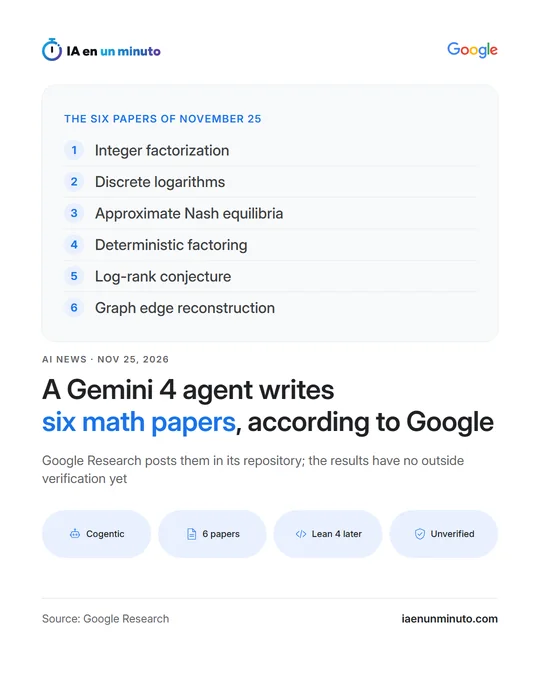
A Gemini 4 agent writes six math papers, according to Google
IA en un minuto newsroom · Editor: Jon Elgezabal
In 30 seconds
Cogentic, an agent system built on Gemini 4, is credited with six works in mathematics and the theory of computation that Google Research has put on GitHub; by the texts, the opening prompt was the only human input. The topics are factoring, discrete logs, Nash equilibria, log-rank and graphs. Lean 4 checks are due later and no outside review is cited.
Google Research has added to its GitHub repository six papers in mathematics and theoretical computer science that, according to the accompanying texts, were written entirely by Cogentic, an agent system for discovering proofs that uses Gemini 4 as its base model. They are dated November 25, 2026. The same texts state that there was no human involvement beyond the initial prompt asking it to generate the proof and its formalization.
The papers cover integer factorization (one with a randomized algorithm and one deterministic), discrete logarithms in finite fields of small characteristic, approximate Nash equilibria in two-player games, the log-rank conjecture and graph reconstruction. The Nash paper describes a polynomial-time algorithm that guarantees a maximum regret of 1/5, against the earlier barrier of 1/3 and a bound of roughly 0.30954 from Li and Li (2026). The log-rank paper improves Lovett's bound by a polynomial factor. The edge reconstruction paper settles Harary's conjecture, from 1964, only for graphs with at least a thousand times more edges than vertices.
Cogentic was introduced in an arXiv preprint dated September 30, signed by seven researchers from Google Research and Google DeepMind. It then used Gemini 3.1 Pro or an early version of Gemini 4 Argon, and its abstract said experts had independently verified the results of that moment, in online learning, auction theory and mechanism design. The repository already held four other papers, dated October 30, November 18 and November 23 (two).
The texts of these six papers do not mention outside verification. The authors say they have also completed a formalization of each proof in Lean 4, a language that lets a computer check a proof step by step, and that it will be released later in a companion submission. The repository states that it is not an official Google product.
Why it matters · analysis and opinion
What sets this apart from other AI math announcements is the format: not a single proof but a batch of papers with their texts in an open repository that any specialist can read and challenge. The decisive pieces are still missing: mathematicians outside Google validating the arguments, and the announced formalizations that would let a computer check every step. Until then it is a claim by the company, not an established result. For a small business there is no direct use; the useful signal is that agents with a propose-and-check loop are already producing research work, and that the bottleneck moves from generating to verifying. Anyone using agents in their business can copy the idea: whoever proposes should not be the one who signs off.
Official source: Google Research · Written with the help of AI: how we make the news