Stanford and OpenAI researcher posts preprint claiming to partly unite gravity and quantum mechanics
IA en un minuto newsroom · Editor: Jon Elgezabal
In 30 seconds
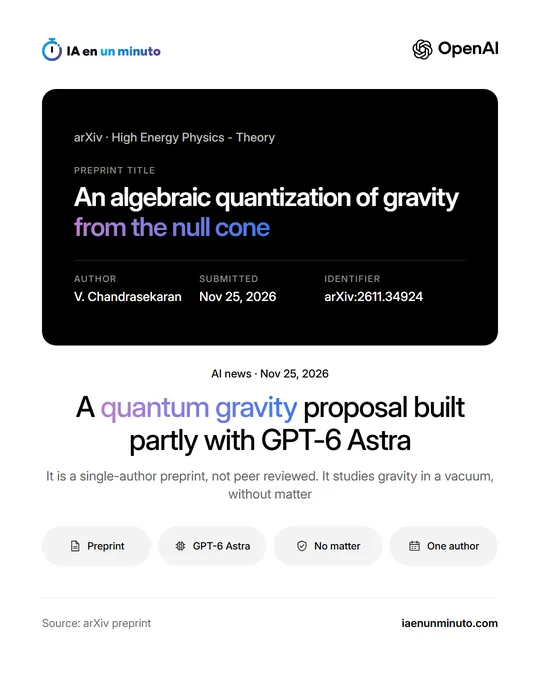
Venkatesa Chandrasekaran uses arXiv to set out a route for treating relativity in quantum terms when no matter is present. GPT-6 Astra helped with part of the sums and proofs, as the writer acknowledges. The outcome still awaits validation, includes at least one step lacking rigorous proof and leaves basic questions open.
Venkatesa Chandrasekaran, a Stanford University physicist who also works with OpenAI, is the sole author of a preprint, meaning a scientific paper still awaiting peer review, that offers a way to reconcile gravity with quantum mechanics. It was submitted to arXiv on 25 November.
The idea is to quantize general relativity in a vacuum, with no matter involved, working on the light cones that bound a region of spacetime. The author argues that his construction yields the Bekenstein-Hawking entropy, which physics links to black holes, and that Einstein's equations emerge as a low-energy approximation.
Artificial intelligence has an acknowledged role. In the full paper, Chandrasekaran writes that a number of calculations and proofs grew out of a sustained exchange with GPT-6 Astra, an OpenAI model, over many months, using roughly 400 million tokens (the units of text the system processes). He also thanks the company for the computing power.
Checks are still pending. The work itself calls one step of the argument heuristic, in other words not rigorously proven. Xataka notes that it currently offers nothing measurable and that Jonathan Oppenheim of University College London, who backs a rival theory, says it solves none of the major open problems.
Why it matters · analysis and opinion
The slowest stage lies ahead before this could count as an accepted result: other physicists need to redo the steps, hunt for mistakes and judge whether the starting assumptions are reasonable. Unlike a mathematical proof verified by computer, no automatic checker can settle the debate here, and a physical theory must also face observation. The telling detail about AI is how it was used: a long dialogue steered by an expert, rather than a system delivering an answer on its own. Readers seeing headlines about a theory of everything should lower expectations and wait for independent assessments.
Source: arXiv · Written with the help of AI: how we make the news