GitHub is rebuilding its code storage as activity from AI agents grows
IA en un minuto newsroom · Editor: Jon Elgezabal
In 30 seconds
GitHub is overhauling the system that holds its repositories, pushed by a workload that AI agents have sent soaring in just one year. Data will no longer sit in complete copies spread across local disks but move to Azure Blob Storage, with lightweight machines handling reads. In its tests, the new design handles up to 35 times more writes.
GitHub is rebuilding the infrastructure where Git repositories are stored, after a year in which activity on the platform from developers and AI agents has multiplied. The company laid out the plan on Tuesday, October 6, on its engineering blog.
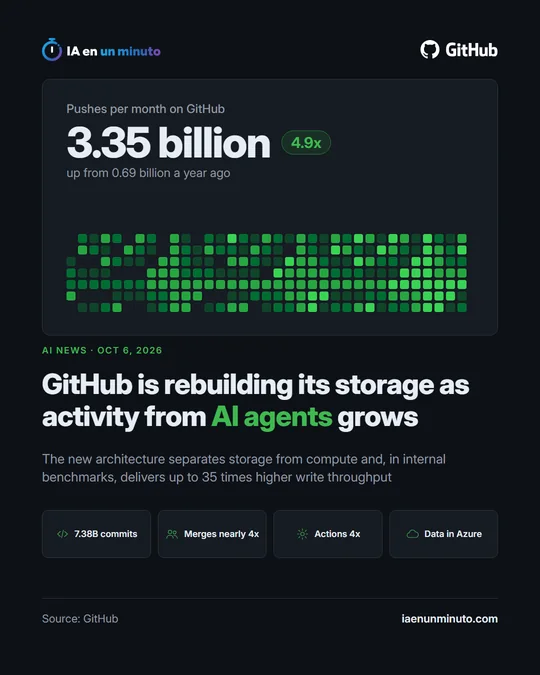
Commits (each change saved to the code) totaled 7.38 billion on GitHub in September, counting those from developers and from agents, over five times the figure of a year before. Pushes (which send those changes to the server) now run at 3.35 billion a month, 4.9 times the 0.69 billion recorded a year ago. Merged pull requests (change proposals that get accepted) are at almost four times last year's volume, and GitHub Actions, the company's automation service, logged 3.26 billion runs in September, more than four times the number of a year earlier.
Taken together, Git activity on the platform rose from 218.2 billion events a month in September 2025 to 473.3 billion in August 2026. In August the most active repository received roughly a billion requests. GitHub explains that an agent commits after almost every action and holds off until each push has finished before continuing, which turns delays no person would notice into the limiting factor.
So far a system called Spokes has stored every repository as a complete copy on the local disks of multiple servers, five by default. The new architecture separates storage from compute: repository data is kept in Azure Blob Storage, Microsoft's cloud storage service, while lightweight servers act as a cache for reads. GitHub's internal tests showed write capacity as much as 35 times higher.
GitHub says the change is being made with the service still running and without asking anybody to work differently. It has given no date for finishing.
Why it matters · analysis and opinion
Until recently, a service like GitHub was sized with people in mind, who save changes every so often. An agent works differently: it saves after almost every step and waits for the server to confirm before carrying on, so any delay piles up. That GitHub has to rebuild its foundation for this reason shows how much work development teams are already handing to these programs. For people using the platform, the promise is that day-to-day work does not change. Where it may show most is in projects with heavy continuous integration and several agents at once, exactly the workloads the company itself singles out as the most demanding. What is still missing is when the change will reach every repository, because there is no timeline.
Official source: GitHub · Written with the help of AI: how we make the news