A Claude agent can now put up to 1,000 agents to work on a single task
IA en un minuto newsroom · Editor: Jon Elgezabal
In 30 seconds
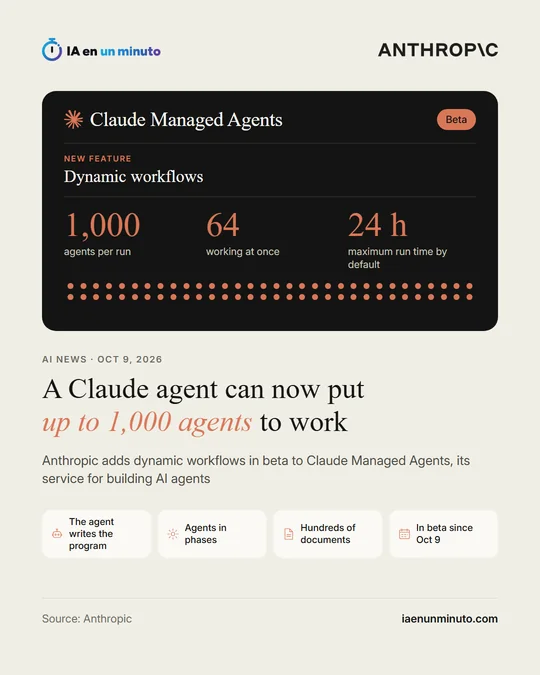
Anthropic has given Claude Managed Agents a beta feature that lets one agent split a large job among many others. The agent drafts a program that launches them in stages, merges their results and stays in the background on the server. Each run allows up to 1,000 agents, 64 of them simultaneous, lasts 24 hours at most by default and is billed by what every model consumes.
On Friday, October 9, Anthropic added dynamic workflows to Claude Managed Agents, its managed service for running Claude as an autonomous agent through the API. The feature is in beta, according to the platform's release notes.
It is designed for work with many pieces, such as reviewing hundreds of documents or cross-checking many sources. Instead of doing everything itself, the agent writes a workflow, which is a program that runs many agents in phases and combines what each one returns. The server runs it in the background while the agent keeps working or ends its turn. Because those agents can work at the same time, a long task can finish sooner than if one agent did each piece in turn, the documentation explains.
The program can run several agents at the same time, pass the result of one agent to another, repeat a step (for example, having a draft revised until it passes a review or a set number of rounds is used up) and determine what happens when one of its agents fails. Each agent works in its own thread, and a session can have several runs open at once.
According to the page that details the limits, each run can start up to 1,000 agents over its whole life, with 64 working at once. Anthropic warns that this second number is not guaranteed and can change. If the workflow asks for more than 1,000, the server does not start another agent and the run ends with an error. By default, a run can last up to 24 hours, and the agent can set a shorter lifetime when it starts the run.
The agent itself decides whether a workflow is needed and when to start it, based on the work it is given: there is no separate call to launch one. Developers turn the feature on in the agent's configuration, can guide it through its instructions (when a run is called for, how to split the work or what time limit to give it) and follow progress phase by phase.
The feature has no price of its own. Anthropic bills what each agent uses, at the rates of the model it runs on, and that usage counts toward the session's budget. The documentation recommends keeping runs to the tasks that need them, because every agent in a run uses tokens.
This is not the debut of Claude Managed Agents, which has been in public beta since April 8. Nor is it the debut of workflows: the same release notes record, under May 28, their arrival in Claude Code, Anthropic's coding tool, as a research preview. What is new is that the agents of Claude Managed Agents can now use them.
Why it matters · analysis and opinion
Until now, splitting a large job among many agents meant someone had to program that split: which agent does what, in what order and how the pieces come together. With this feature, the agent itself writes that part, which brings tasks such as reviewing an entire archive of contracts within reach of teams that have no engineers dedicated to orchestrating agents. The trade-off is cost control: the agent decides when to launch a run, and every agent that starts consumes tokens. Anyone trying it would do well to begin with tightly scoped jobs, state in the instructions when a workflow is worth it and set a budget for the session. It is still in beta, so the limits and the behavior may change before the final version.
Official source: Anthropic · Written with the help of AI: how we make the news