Google Play starts letting people open personal apps built with AI in Google AI Studio on their phones
IA en un minuto newsroom · Editor: Jon Elgezabal
In 30 seconds
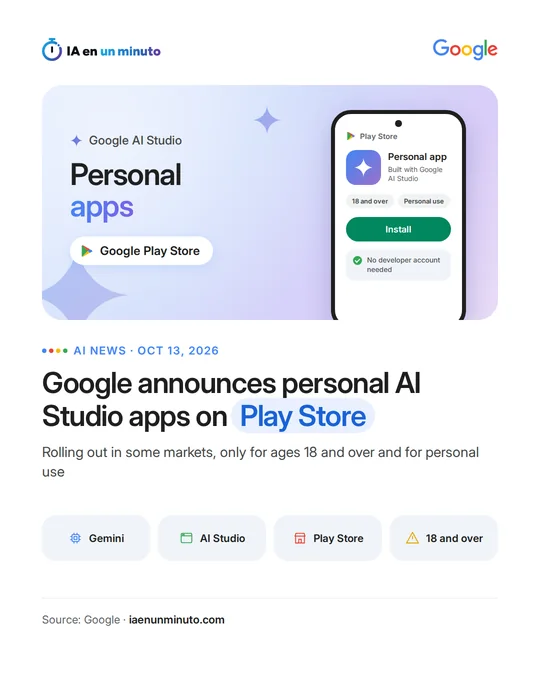
Google now lets people open the apps they build with Google AI Studio on their own Android phones via Google Play, using the Google account they already have. These apps stay out of the public storefront and are reaching some markets first, the United States included, for anyone 18 or older. Google plans to let users share them with people close to them over the coming months.
Google announced on Tuesday, October 13, that personal apps made with Google AI Studio can now be opened and used on a person's own Android phone through Google Play. AI Studio is Google's tool for building Android apps with AI, a practice known as vibe coding.
All it takes is an ordinary Google account; there is no need to set up a developer account. These apps are private and do not show up in the store's public catalog. The feature is starting to reach some markets, the United States among them, and is limited to people aged 18 and over; Google has not said which other countries will get it.
Over the coming months, the company says, people will be able to share these apps with a small group of close friends and relatives. Anyone who wants to release their app to the general public will be able to move up to a professional developer account; from then on, the app will have to pass the same Trust & Safety reviews and meet the same quality standards required of any developer.
The news comes in a Google blog post on October's changes to Google Play, written by Sam Bright, vice president and general manager of Google Play and the developer ecosystem, which also introduces new ways to discover games.
Why it matters · analysis and opinion
Google brings together in one loop the tool that generates the app and the store that puts it on the phone, something beyond the reach of vibe coding platforms that have no operating system or store of their own. The change is aimed at people who do not code: it asks for no developer paperwork and keeps the app private, so getting it wrong costs little. Freelancers and small firms can use it for very specific internal tools, such as an order log or a shift rota, without hiring someone to build them. What is missing is what matters most for a team: sharing is not possible yet, and Google has not said when it will reach more countries. Where it is already available, the sensible move is to start with a small task before trusting it with important data.
Official source: Google · Written with the help of AI: how we make the news