OpenAI and Anthropic ask the UK Parliament for mandatory AI safety laws
IA en un minuto newsroom · Editor: Jon Elgezabal
In 30 seconds
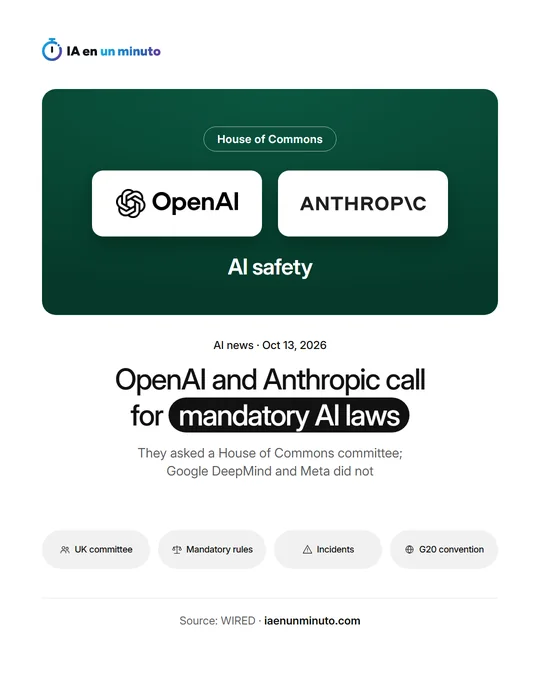
OpenAI and Anthropic asked a committee of UK MPs for binding rules to keep the risks of AI in check. Google DeepMind and Meta, present at the same hearing, did not join that call. The AISI director acknowledged that today he has no way to halt a model even if he judges it too dangerous.
OpenAI and Anthropic argued before the UK Parliament on Tuesday, October 13, that AI safety needs laws that companies must follow and that their voluntary commitments are no longer enough. Google DeepMind and Meta, which appeared at the same session, did not support new legislation.
The hearing was held by the House of Commons Business, Innovation, Science and Trade Committee, which is made up of MPs from several parties. Besides the four companies, senior UK officials gave evidence, as did four former employees of those labs who have spoken out about their practices. One of them, Daniel Kokotajlo, who used to work at OpenAI, told MPs: "I don't think the companies can be trusted to self-regulate."
Liam Booth-Smith, who leads Anthropic in Europe, answered that "the rules should be binding" when asked whether AI safety now needs a legal framework, and noted that his company has always held that voluntary commitments fall short. Tom Duff Gordon, a vice president at OpenAI, was more cautious: he backed a legal framework and an international convention, and asked for some elements to be mandatory, beginning with the reporting of incidents.
The other two companies did not follow. Asked directly about a legal framework, Owen Larter of Google DeepMind replied that his company would focus on standards. Rob Sherman of Meta pointed out that the UK already has its own regulators and is not starting from scratch.
In the last part of the session, officials admitted how little the current system requires of anyone. The UK AI Security Institute (AISI) evaluates the most advanced models before they come out, but only if the companies decide to give it access. Its director, Henry de Zoete, admitted that the institute depends entirely on cooperation from the companies and from foreign governments, and that it could not prevent a company from launching a model that AISI considered too dangerous. Cat Little, the highest-ranking civil servant at the Cabinet Office, the department AISI sits within, confirmed that for now the whole system is voluntary.
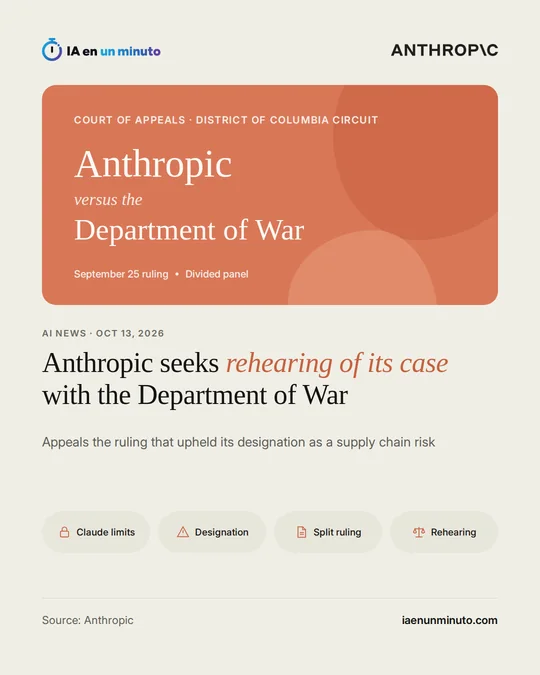
Booth-Smith said Anthropic was unable at the time to give AISI full, unrestricted access to its Mythos 5.1 model, a matter he referred to the US government, and added that the institute now has that access. Duff Gordon explained that OpenAI hands its models over before launch to CAISI, the equivalent body in the United States, and to the UK's AISI, and will keep doing so for as long as the US government allows it.
The appearance was announced in September as part of a committee inquiry. Its chair, Liam Byrne, invited the four companies at the time and asked them, among other things, whether they would agree to report serious incidents on a mandatory basis, as City AM reported.
After the hearing, Byrne told WIRED that the committee wanted to bring out the wide differences of opinion between these companies and to show that voluntary self-regulation cannot be relied upon. He also wants the UK government to use its upcoming G20 presidency, to be followed by South Korea's, to push for an international AI agreement that is not tied to the current White House.
Why it matters · analysis and opinion
None of this binds anyone yet: in the UK, whether a model is tested before release still depends on each company's goodwill, and a hearing only puts positions on the record. What is new is that the split among the big labs is now written down before a parliament, with two of them calling for binding rules and the other two relying on standards and on the regulators that already exist. The fact that the body that evaluates the models admits it cannot stop them explains why the committee is pushing toward legislation and toward an international agreement. For anyone using these tools nothing changes right away; the thread to watch is mandatory incident reporting, the first measure OpenAI proposed and one of the questions the committee had already put to the four companies.
Source: WIRED · Written with the help of AI: how we make the news