Anthropic says Claude outperformed the best published quantum circuit designs
IA en un minuto newsroom · Editor: Jon Elgezabal
In 30 seconds
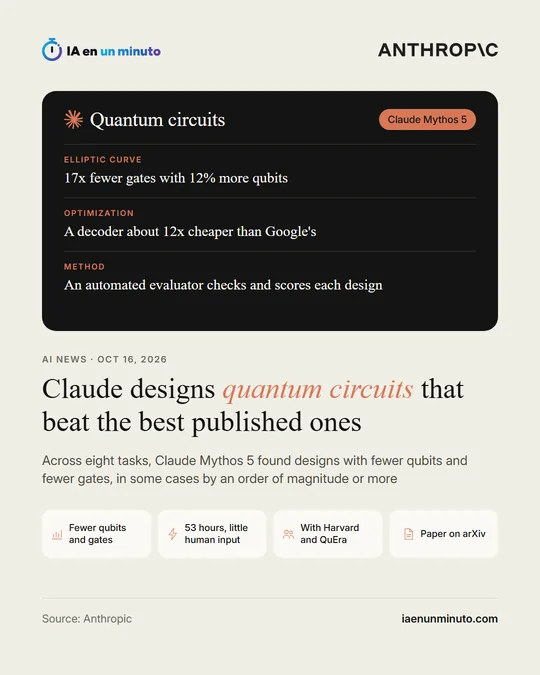
Anthropic got one of its models, Claude Mythos 5, to find quantum circuits that are cheaper than the known records on eight problems in chemistry, optimization, physics and mathematics. The model worked almost alone, guided by a program that verified and graded every proposal. On the elliptic-curve test it spent 53 hours and came up with a design using 17 times fewer gates in exchange for 12% more qubits.
Anthropic published work on Friday, October 16, in which Claude designed quantum circuits (the sequences of operations, called gates, that a quantum computer applies to its qubits) that are smaller than the best ones published so far; in some cases, ten times better or more. It used Claude Mythos 5, one of its models. The company says improvements like these cut the resources that useful applications demand, so practical quantum computers could arrive sooner than expected.
The starting point is scarcity: the quantum machines built to date have between hundreds and thousands of qubits, which are very sensitive to noise, and that is not enough for many of the algorithms that promise an edge over classical computing. That is why researchers have spent years reworking algorithms so they use fewer qubits and less time. Anthropic gives the example of simulating FeMoco, an iron-sulfur cluster in a bacterial enzyme: its estimated cost has fallen roughly 150,000-fold since 2017, in an eight-year effort shared among many groups.
The team described eight tasks in chemistry, optimization, physics simulation and number theory to Claude in everyday language, and gave it an evaluator program that reviews whether each proposal is correct and scores it by the qubits and gates it needs. Claude wrote the design in Python, got its score and fixed it, with nobody stepping in between one round and the next. In all eight tasks it reached designs with fewer qubits and fewer gates than the best known.
The company details two results. The first is elliptic-curve point addition, one of the field's reference tests. Claude started from a single-paragraph brief and worked for 53 hours; human help was limited to that brief and the odd nudge to widen its search. It arrived at a new approach, and one of its designs needs 12% more qubits than the smallest published one, but 17 times fewer gates. To check it, Claude also wrote proofs in Lean. The second is a quantum optimization algorithm called DQI: Claude rebuilt the decoder, its most expensive step, and cut its gates 12-fold compared with Google's earlier construction.
Anthropic admits a limitation. In the first tests, Claude was overly cautious: it doubted the improvements it found, went back over results that were already well supported and leaned towards familiar methods. To fix this, the team required it to develop several different approaches at once and, from time to time, asked it to open up its search. The company compares this with the FeMoco case: that reduction took eight years, while the elliptic-curve design came out of a single 53-hour run.
The work was led by Andi Gu, from Anthropic's STEM Fellows science fellowship program, with Alek Kemeny, a quantum physicist at the company, and with Susanne Yelin (Harvard) and Mikhail Lukin (Harvard and QuEra Computing). The full paper is on arXiv, submitted on Thursday, October 15. Anthropic notes that circuit design is only one part: a useful quantum computer also has to correct its own errors and control its hardware, among other components.
Why it matters · analysis and opinion
The interest lies less in any single record than in the method: a model that proposes, gets an objective score and corrects itself, without stopping, in a field where each step forward used to cost specialist teams months. But the savings are still on paper, because today's machines remain short of qubits for many of these algorithms. Two things are missing to gauge its real weight: other groups reviewing and reproducing the paper's results, and the same approach working on pieces such as error correction, which Anthropic itself points to as the rest of the road. The lesson goes beyond physics: when a problem can be written as code and scored automatically, it is worth testing whether an AI agent finds solutions nobody had seen.
Official source: Anthropic · Written with the help of AI: how we make the news