The Generalitat announces an AI assistant on WhatsApp to detect online scams from December
IA en un minuto newsroom · Editor: Jon Elgezabal
In 30 seconds
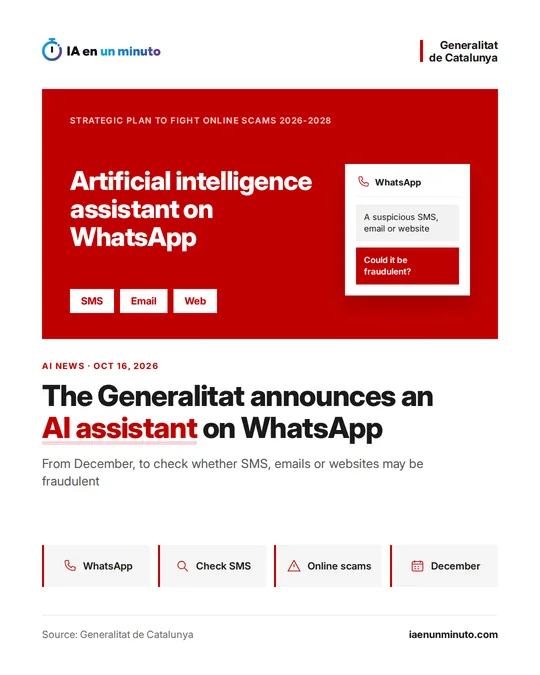
In December, a Generalitat de Catalunya AI assistant will arrive on WhatsApp so people can ask whether an email, an SMS or a website is a fraud attempt. It is being prepared by the Cybersecurity Agency of Catalonia, which will also offer it on its website along with tips for staying safe. The Mossos d'Esquadra, who receive an average of 220 reports a day about online scams, will also open a virtual police station.
The Generalitat de Catalunya, the Catalan regional government, will switch on an artificial intelligence assistant on WhatsApp in December that people can turn to with digital security questions. The Cybersecurity Agency of Catalonia presented it this Friday together with the Mossos d'Esquadra, the Catalan police, as part of the Strategic Plan to Fight Online Scams 2026-2028, which the Catalan government plans to approve next Tuesday.
Laura Caballero, the Agency's director general, explained that sending it a message will be enough to find out whether an SMS, an email or a web page that raises suspicion may be a fraud. In her view, beyond raising awareness, people need to be given "instruments". According to VilaWeb, the assistant will also be available on the Agency's website, will help people assess whether they have already fallen victim to a scam and will offer security tips, such as how to set up an email account so that it is secure. Until now, the Agency had a WhatsApp community where it warns about risks and scams. Caballero noted that people over 65 are the hardest hit, according to EixDiari.
According to the Mossos, online scams are the second most reported crime in Catalonia, behind only theft, with an average of 220 cases a day and roughly 80,000 a year. Between 2024 and August 2026 they caused losses of 490 million euros and affected more than 200,000 victims. The plan starts with 1.8 million euros and includes working with banks, online marketplaces and mobile operators.
The Mossos expect to open a "virtual police station" in November, according to EixDiari and VilaWeb, for reporting online scams and payment fraud without going to a station in person; El País places it at the end of the year. Miquel Àngel Garcia Alvira, head of the Mossos' General Commissariat for Information and Communication Technologies, said it will let people attach digital evidence.
The sources do not say which AI model the assistant will use, who is building it or the exact day in December when it will be available.
Why it matters · analysis and opinion
Having a public body offer the filter changes the starting point: until now, clearing up doubts about an odd message meant asking someone you trust or searching online. Bringing the check to WhatsApp puts it where many of these scams already arrive, and within reach of older people, the group the Agency itself singles out as the hardest hit. Questions remain open: which model is behind it, what happens to the messages forwarded to it and how well it does with new scams. Until it arrives, the useful advice is the usual one: do not tap links in unexpected messages, confirm through another channel and report it. Catalan companies that suffer impersonation will also have a public resource to recommend to their customers.
Source: EL PAÍS · Written with the help of AI: how we make the news