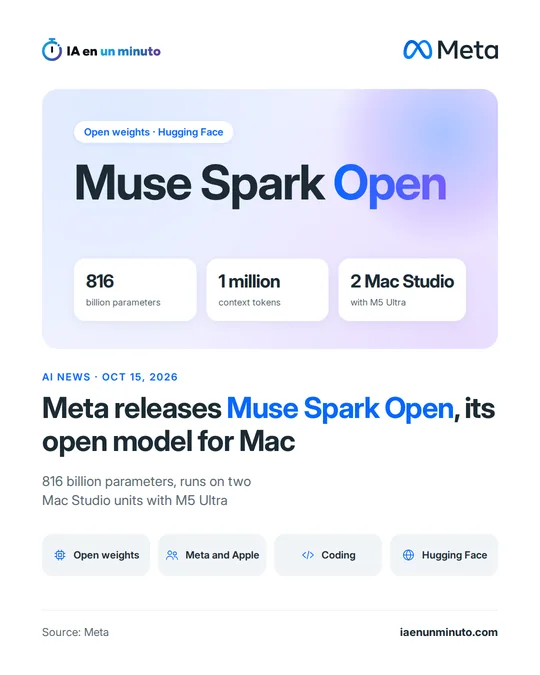
Meta releases Muse Spark Open, an open model designed with Apple to run on two Mac Studio computers
IA en un minuto newsroom · Editor: Jon Elgezabal
In 30 seconds
Meta has released Muse Spark Open, its new multimodal model with 816 billion parameters that handles 1 million tokens and is aimed at coding and agent work. According to the company, no model of its category had run on a desktop before, and this one does so on two Mac Studio machines with M5 Ultra. The weights are on Hugging Face under the Muse Model License, which many developers can use for free.
On Thursday, October 15, Meta released the weights of Muse Spark Open, a multimodal model that anyone can download and that, according to the company, is the most capable US open-weight model to date. It has 816 billion parameters in total, 42 billion of which are active at each step, and it handles up to 1 million tokens of context. Meta is aiming it at coding, agent work and long tasks that call for reasoning over several steps.
What sets it apart is that it can run on a desktop. Meta says it is the first in its class able to do so, split across two Mac Studio computers with the M5 Ultra chip and the latest version of MLX, Apple's framework for running AI models. Each of those computers can give up to 512 GB of memory to its graphics processor, so between them they hold the whole model. In its developer guide, Meta also mentions the option of four 256 GB Mac Studio machines and names Apple among the companies it worked with so the model would run from day one. According to Expansión, the model was designed jointly with Apple, Meta is thereby returning to open models after the Llama family, and Mark Zuckerberg credited the deal to his collaboration with John Ternus, who took over from Tim Cook as head of Apple on September 1.
The weights can be downloaded from Hugging Face, Microsoft Foundry, Google Cloud Model Garden and Amazon SageMaker AI, and the model is also offered through an API on Together AI, OpenRouter, Groq, Fireworks AI, Baseten, Modal and Nebius. It is distributed under the Muse Model License, whose limited commercial terms let many developers use it for free. According to the Hugging Face blog, the full BF16 version takes up about 1.5 TB and its reasoning cannot be switched off; the previous model in the series, Muse Glimmer, is a small one Meta launched in August.
Meta says the model received additional safety training and met the thresholds its risk framework requires for release. The full report on that evaluation will come later.
Why it matters · analysis and opinion
Until now, a model in this category required a cluster of graphics cards or paying a cloud provider for every query. Being able to run it on two desktop computers changes the math for anyone working with information they would rather keep inside their office: law firms, consultancies or development teams that want a powerful coding assistant without sending their code outside. The hardware needed is not within everyone's reach and the license has commercial limits, so it is worth reading its terms before building a product on top of it. For most, the sensible path will be to try it first through an API with one of the providers and then decide whether running it in-house pays off. The collaboration with Apple also positions the Mac as a serious platform for local AI.
Official source: Meta · Written with the help of AI: how we make the news