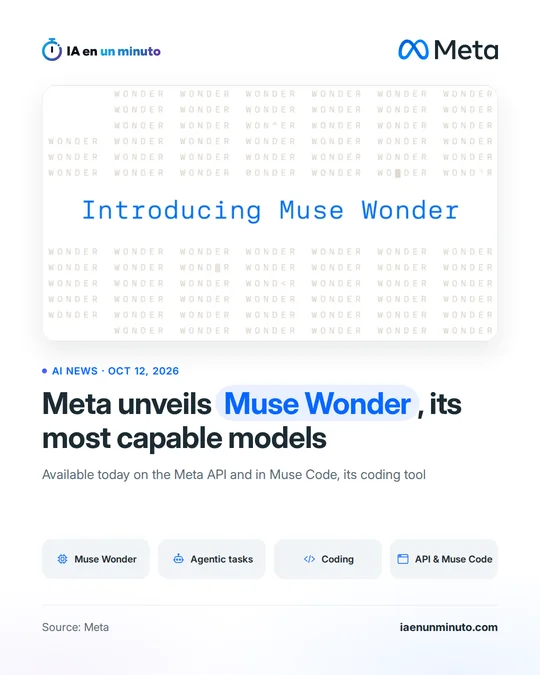
Meta introduces Muse Wonder and Muse Wonder Full, its most capable models for agentic tasks
IA en un minuto newsroom · Editor: Jon Elgezabal
In 30 seconds
Meta is rolling out the Muse Wonder series, two AI models meant to let an agent handle jobs in law, finance, health and programming. Muse Wonder is open from today in Muse Code and the Meta Model API, while Muse Wonder Full is limited to Muse Code subscribers. Both add Active Memory, which keeps information between conversations, and Active Focus, which stops them from dropping a difficult task.
Meta has unveiled the Muse Wonder series today, fourteen months after it started rebuilding its AI work.
The series is made up of Muse Wonder and Muse Wonder Full, which Meta describes as the most capable models it has released so far. They are aimed at agent tasks, both personal and professional, in law, finance and health, and also at programming. The examples Meta gives are handling an insurance claim, understanding a rental contract and building an app that works. Both build on the work done with Muse Spark, the first model from its new lab, announced in April, as Wired recalls.
Muse Wonder can be used from today in the Meta Model API, the company's API for developers, and in Muse Code, its tool for programming with AI. Muse Wonder Full is out today as well, for people who subscribe to Muse Code. Muse Wonder is due to reach more parts of Muse, Meta's personal agent, soon, with subscribers getting it first. Meta's post gives no prices and no date for that rollout.
The models come with two new features. Active Memory holds on to what matters from one conversation to the next and retrieves the details that are useful for the task in progress. Active Focus keeps the model on course toward the goal when a task becomes difficult: it tries other routes, recovers from mistakes, asks for clarification if it needs it and checks with the user before taking an important step.
Meta says it trained them not to share private information unless they have permission and to refuse requests for help with harmful acts, while leaving developers and security teams able to use them to look for weaknesses in their own code. It adds that the release follows its Meta Superintelligence Scaling Framework and that a fuller report, with more safety evaluations, is on the way.
Wired reports that Meta places the largest version just below Claude Opus 5.5, Anthropic's best model, and above Claude Fable 5.1 in the Artificial Analysis Intelligence Index, a widely used index that sums up model capabilities in a single score. Meta also says it beats those two and OpenAI's GPT-6 Astra in some specialized tests, including ones on working with legal documents and on building software. The same outlet notes that such tests do not always reflect performance in real use, and that Meta has not explained how the models were built or trained.
The rebuilding Meta refers to involved, Wired recounts, putting billions last year into Meta Superintelligence Labs, a newly created lab, and hiring Alexandr Wang, former chief executive of Scale AI, to run it.
Why it matters · analysis and opinion
Meta had been outside the leading group for some time and this launch puts it back there, at least by the results the company itself gives, which Wired notes do not always reflect real use. The practical part lies elsewhere: memory across conversations and persistence on a hard task are exactly what fails when an agent is handed a long job. That the model arrives first in the API and the coding tool shows who Meta is addressing at the start: people who build products, not the general public. For a law firm, an accounting practice or a clinic, the open question is reliability, and the promised safety report is still missing. Until it arrives, the sensible course is to try it on narrow tasks and without sensitive data.
Official source: Meta · Written with the help of AI: how we make the news