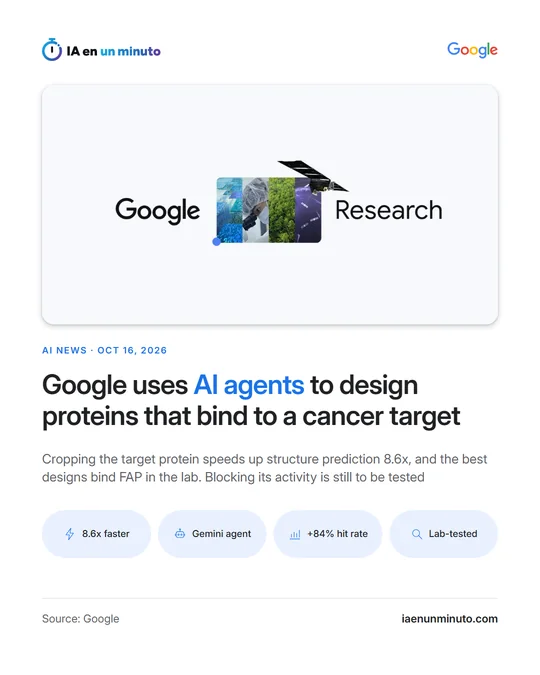
Google uses AI agents to design proteins that bind to a cancer target
IA en un minuto newsroom · Editor: Jon Elgezabal
In 30 seconds
A Gemini agent took the lead in a Google Research campaign to build custom proteins against a target that is abundant in solid tumors. What makes it affordable is keeping only the piece of the target where contact happens: the computation then flies and the GPU bill shrinks to a fraction. The four molecules that made it to measurement gripped their target with the strength expected of a drug.
Google Research has explained how it designed from scratch proteins able to grip FAP, a protein that is abundant in many solid tumors and that laboratories use as a cancer target. It did so on Friday, October 16, on its research blog, with an AI agent steering part of the work.
The central piece is what they call epitope excision: cropping the target protein and keeping only the area where the binding happens. The FAP domain they worked with has 719 amino acids, and recomputing its whole shape on every pass was very expensive. With windows of 85 to 130 amino acids, according to the technical paper that accompanies the announcement, structure prediction with AlphaFold 3, the Google DeepMind program that works out the shape of a protein, runs 8.6 times faster and uses 88 percent fewer GPU hours. In a test with 15 targets and 3,666 designs, the crops left the contact area almost the same as the full protein: a median deviation of 0.37 angstroms, the scale on which atoms are measured.
On the same compute budget, the team compared three ways of running the FAP campaign: a researcher working alone; a researcher paired with an agent based on Gemini 3.1 Pro, Google's AI model, which decides where to bind and how to spread the computation; and the agent on its own. The pair won, going from 5.06 to 9.33 percent of valid designs, 84 percent more, while spending roughly 58 percent of the GPU budget. The autonomous agent chose by itself to stop at around 94 percent of the budget it had.
Then they left the computer behind. They tested a library of 5,000 candidates in yeast and, after three rounds of screening, 571 enriched sequences remained, 60 of them identical to designs made on a computer. Of those, four went through the affinity measurement: between 3.0 and 9.1 nanomolar, the degree of tight binding sought in a drug and which, according to Google, usually arrives only after many rounds of laboratory work.
The team itself sets out the limits. It leaves for later the assays that would say whether these proteins get as far as slowing down FAP's activity and whether they tell its domains apart, and it warns that the comparison between researcher and agent was done with a single target, a single kind of scaffold and a single AI model.
The announcement comes alongside two more pieces of work from the same group: VERID, a digital twin of the laboratory that simulates each command before a robot carries it out, and a trial with DNA aptamers in which the agents corrected their own mistakes between rounds. Google says it chose non-infectious biological systems, that every designed sequence goes through a biosecurity screening, and that a person authorizes and reviews the designs and supervises the robots.
Why it matters · analysis and opinion
The bottleneck in AI protein design has never been imagination but the bill: every candidate has to be folded on a computer, and the cost grows with the size of the target. Cropping the target changes that arithmetic and, along the way, turns choices that used to belong to the lab (where to bind, how much surrounding structure to keep) into parameters an agent can tune tirelessly. The striking part of the experiment is that the human-agent pair beat both the scientist alone and the agent alone: what paid off was the division of roles, not autonomy. For a small biotech firm, this brings within reach campaigns that until now demanded an unaffordable compute budget. What is missing is the usual: that these molecules do something useful in a living body, not merely stick.
Official source: Google Research · Written with the help of AI: how we make the news