OpenCode suffers a security breach that may have exposed its users' OpenAI and Anthropic keys
IA en un minuto newsroom · Editor: Jon Elgezabal
In 30 seconds
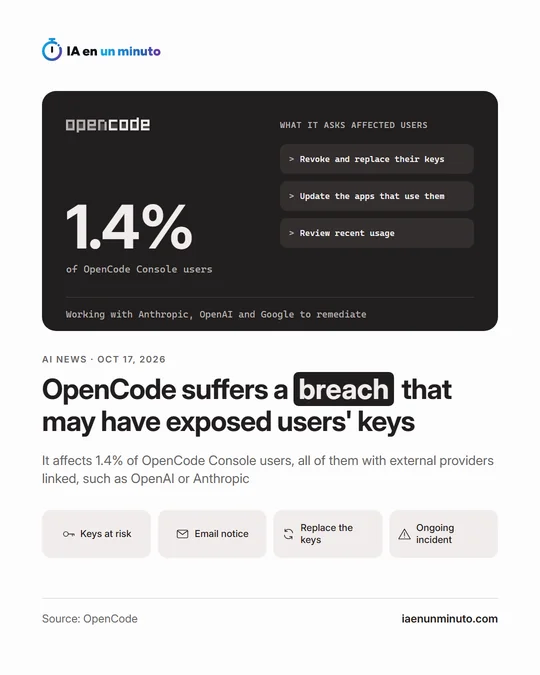
OpenCode said on Saturday that someone got into an old system without permission and may have seen keys from outside providers like OpenAI or Anthropic, saved by 1.4% of the people using its Console. The company has written to everyone affected so they cancel those keys, generate others and keep an eye on their recent consumption. The incident remains open and OpenCode links it to a distillation attack, without yet explaining how it happened.
OpenCode, the open-source AI coding agent, reported on Saturday, October 17, a security breach affecting 1.4% of the users of OpenCode Console. It announced it on X, explaining that the breach took place the previous night and is tied to "a large scale distillation attack". Distillation means training one AI model on the answers produced by another.
According to OpenCode, those affected are part of the users who had external providers connected, and all of them received an email that same morning; anyone who has not received one is not affected. As Cybersecurity News points out, the figure refers to Console users, not to everyone who uses OpenCode.
That outlet reports what the notice says: the company detected unauthorized access to an old system it was already getting ready to close, and keys for external providers kept in users' workspaces, such as OpenAI or Anthropic ones, may have been exposed. These are the keys that let other applications use those providers' models. The notice talks about possible exposure: it does not confirm that each key was stolen or used.
OpenCode asks those who got the email to revoke the keys and create new ones from each provider's dashboard, update the applications relying on them and check recent usage in case any unexpected activity shows up.
The company says the incident is still open, which is why it cannot give more details, and that it is working with Anthropic, OpenAI and Google to fix it. Its statement does not explain how the attackers got in, how long they were inside or how many keys are at stake, nor whether the exposed credentials were used for the distillation attack.
Why it matters · analysis and opinion
Tools that bring several AI models together in one place have become convenient, but they concentrate something valuable: the paid keys for each provider. If that intermediary fails, the problem does not stay with it, because whoever holds the key can spend on the owner's account or use it for whatever they want. This case shows it well and also points to a less visible risk: old systems nobody has finished switching off. Any team using services of this kind does well to have a separate key for each tool, set spending limits in the provider's dashboard and know how to replace them in minutes. Even if no email has arrived, reviewing which keys are stored in third-party services is a cheap exercise.
Source: OpenCode · Written with the help of AI: how we make the news