IA en un minutoNewsBusiness and products
Anthropic publishes how AI has changed its workforce: fewer junior hires and more agents
IA en un minuto newsroom · Editor: Jon Elgezabal
In 30 seconds
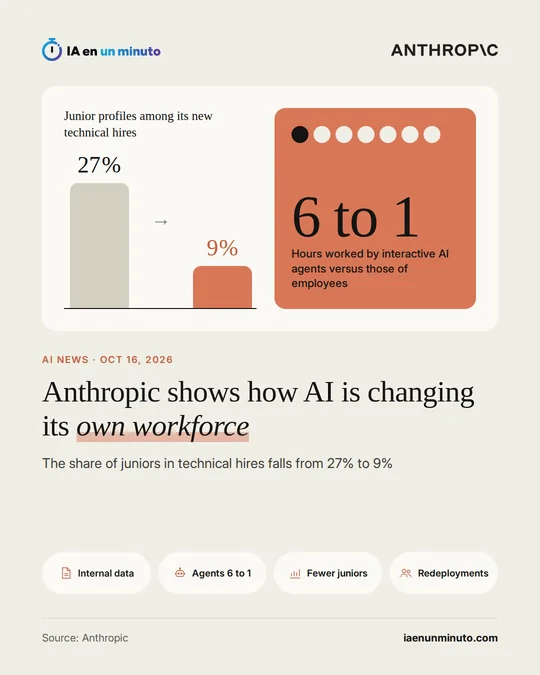
An internal study by Anthropic shows that juniors have gone from 27% of its technical hires to just 9%. In August, its interactive AI agents were already logging six hours of work for every hour put in by staff, and what each employee delivers has grown in code, sales and contracts. To get ahead of it, the company watches threatened jobs with an alert system and prefers to move its people to other roles in-house.
On Friday, October 16, Anthropic published a report from its economic research area on how AI is transforming work and employment inside the company itself. It is signed by Nathan Wilmers, Regina Catipon, Maxim Massenkoff and Peter McCrory, and draws on internal data on staffing, hiring and the use of Claude agents, along with interviews and employee surveys.
Since early 2025, the weight of junior profiles in technical departments has dropped from 21% to 14%, and among new technical hires the fall is even sharper: from 27% to 9%. Job postings for junior roles have shrunk above all since December 2025. According to the report, people inside the company began talking about lower demand for these profiles in January 2026, in the teams that leaned on Claude the most to write code and track down bugs. Technical hiring, even so, keeps growing in absolute numbers.
Combined work hours of autonomous and interactive agents overtook those of people for the first time in March 2026, and by August interactive agents alone were logging six times the hours of employees. For that comparison, Anthropic measures agent runtime in employee-directed sessions and calculates human hours on the basis of 40-hour work weeks.
As agents spread, the company began producing more code per person, closing more sales per rep and handling more contracts. Code commits per engineer are five times what they were six months ago, and tracking the same employee over time, their output rose when they took up the new tools.
The report argues that human attention has become the bottleneck: even in non-technical roles, reading everything an employee's Claude agents generate would take up half of that person's work week. That is why staff spend more and more time on what the text calls "meta-work": building tools to see what agents are doing and keeping watch over their processes. In interviews with technical candidates, comments on their autonomy and judgment are what has grown most, while technical specialization carries less weight.
In response, Anthropic has launched an early warning system that cross-checks demand and productivity indicators for each role against AI capabilities and use, so affected employees can be moved in time, and it gives priority to internal redeployments. The report itself warns that many of its practices cannot be replicated across the rest of the economy and that none of these measures will stop AI from transforming jobs or fix the drop in junior hiring.
Why it matters · analysis and opinion
It is unusual for an AI company to explain how its own technology has changed its workforce, and what weighs most is what happens at the entry door: if first technical jobs become scarce precisely where AI is used most, the effect may spread to other sectors as those tools arrive. The report itself admits that its measures protect those already inside, not those who never get hired. The practical reading for any company is twofold: reviewing what agents produce becomes the scarce work, and that calls for judgment more than technical skill. Teaching newcomers to supervise, and not just to execute, becomes urgent when the tasks people used to learn from are done by a machine.
Official source: Anthropic · Written with the help of AI: how we make the news