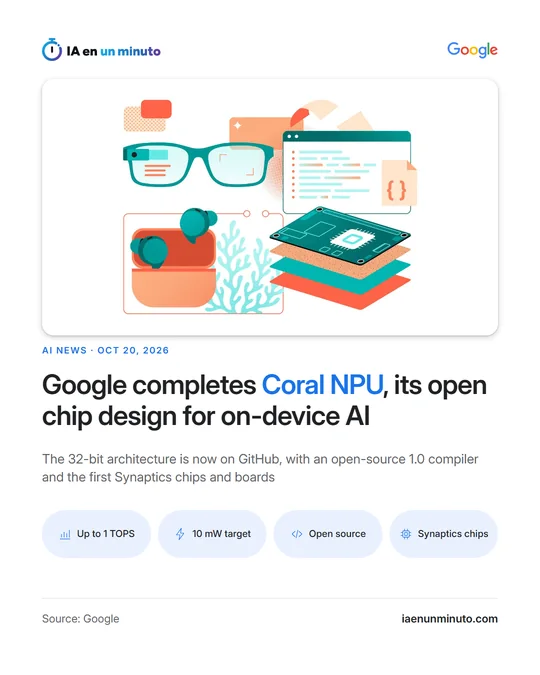
Google completes Coral NPU, its open chip design for running AI on the device itself
IA en un minuto newsroom · Editor: Jon Elgezabal
In 30 seconds
Google Research has finished the 32-bit version of Coral NPU, its open processor for letting AI work inside small devices. The missing piece handles matrix calculations at up to 1 TOPS with a target of 10 milliwatts on average, and the 1.0 compiler accepts JAX, PyTorch and TensorFlow. Synaptics is debuting the Astra SR200 series and the Coralboard SR board, while the Coralboard SL can already be bought from DigiKey.
Google Research has declared the 32-bit architecture of Coral NPU complete. Coral NPU is the open processor design for artificial intelligence (an NPU is a chip specialized in AI) that the company introduced last year, as it explains on the Google blog for developers. The aim is for AI to work inside small devices, such as wearables, earbuds, industrial sensors or robots, without having to check with the cloud at every moment. Google's plan is for those devices to work as a team with the cloud: very low-power models handle the immediate tasks and pass the work on to larger models when more reasoning is needed.
According to Google, those devices are currently spread across hundreds of chip architectures, each tied to its maker, with tools that do not work with one another, and developers have to rebuild and tune their models for each chip. Coral NPU is based on RISC-V (an open standard for designing processors) and seeks to let a model be prepared just once and then taken to chips from different manufacturers.
Over the last year, Google had already released the first three pieces of the design: a control core that can be programmed in C, a vector coprocessor and the memory subsystem. The fourth and final one is a unit for matrix calculations, the operations that take up most of an AI model's time. It can be configured for up to 1 TOPS (one trillion operations per second) and aims for an average consumption of 10 milliwatts when running models. Google says this makes it possible to run compact models such as Gemma, real-time voice translation on wearables or vision for robots from a small battery. The complete 32-bit design is already on GitHub, and Google is working with GlobalFoundries and VeriSilicon to bring it to manufacturing.
Google is also releasing version 1.0 of its open-source compiler (the program that translates models into the chip's language), which accepts models made with JAX, PyTorch and TensorFlow, along with a simulator for testing models before the chip exists.
Hardware is already here. At its Tech Day on October 20, Synaptics is presenting the Astra SR200 series, microcontrollers (small, low-power chips) with Coral NPU technology that come out this month and are meant for battery-powered wearables and industrial sensors, plus a developer board built on them, the Coralboard SR. The Coralboard SL, rated at 1 TOPS, which was shown in a limited edition at Google I/O, is now sold worldwide through DigiKey. The announcement does not give prices. Google is already working on a 64-bit version.
Why it matters · analysis and opinion
The problem it tackles is not power but scatter: every maker of small chips brings its own tools, and that drives up the cost of any product with built-in AI. An open design that several manufacturers can use at once changes that balance, provided that more companies besides Synaptics release chips with it. For anyone developing consumer devices or industrial equipment, the practical advantage lies in not being tied to one supplier and in being able to carry the same model from one board to another. It remains to be seen what the real power draw is, beyond the targets Google gives, and how much the chips will cost. Anyone with a sensor or battery-powered device project on their hands can already get a test board and measure it with their own model.
Official source: Google · Written with the help of AI: how we make the news