IA en un minutoNewsBusiness and products
Town raises $108 million and is now valued at $1 billion
IA en un minuto newsroom · Editor: Jon Elgezabal
In 30 seconds
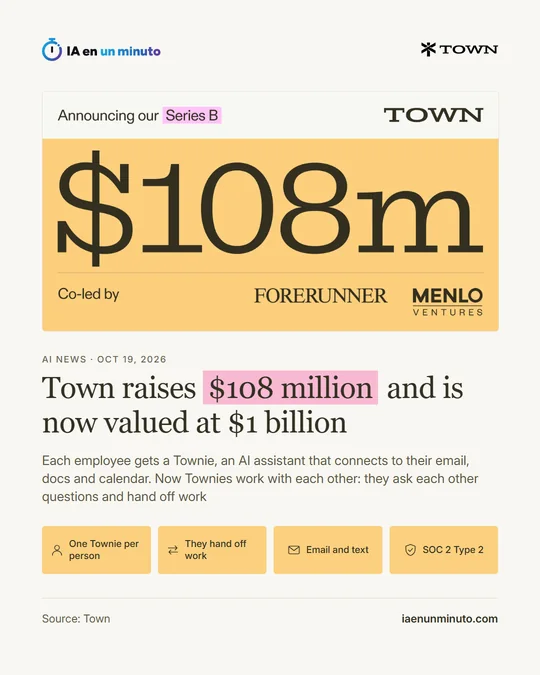
Town has closed a $108 million Series B that values it at $1 billion, according to the startup itself. Its product puts an AI assistant, the Townie, beside every employee, and those assistants now collaborate with one another instead of waiting on anyone. Since July, the company says it has quadrupled the number of customers who pay.
Town, a San Francisco startup that puts an artificial intelligence assistant at the service of every employee, announced a $108 million funding round, its Series B, on Monday, October 19. Forerunner Ventures and Menlo Ventures are leading it; a16z and First Round Capital, which had already invested, are back, and other funds (Sparked Ventures, Serena Ventures, Scribble Ventures, Precedent.vc and Better Tomorrow Ventures) join along with individual investors. According to the company's press release, the deal values Town at $1 billion.
Each person has a Townie, Town's assistant, which links up with their email, documents, calendar and the software they use every day, and gradually learns who they deal with, which projects they are involved in and how they write. What is new is that Townies can now work with each other directly: they consult one another, piece information together and pass tasks along. Each one is still at the service of its own person, shares only what that person would share, asks for permission when it needs to and leaves them the decisions that call for their judgment. They can also deal with people outside the company, such as customers, partners or job candidates, by email and text message. Teams can also share processes: in the company's example, if the business operations team changes the sheets on competitors, every sales rep's Townie prepares calls with the new information from then on.
Town argues that today's personal AI assistants handle tasks at the edges of the day, such as booking dinner or changing a flight, and that none of them solves teamwork: a personal assistant knows its user but cannot deal with the rest of the team, and a team bot sees the shared channels but not anyone's email or preferences. "Now, it can make teams faster together," its co-founder and CEO, Jean-Denis Greze, said of AI in the press release. Shawn Carolan, a partner at Menlo Ventures, recalled that the firm invested in Siri in 2008 and said Town "has wisely chosen business over pleasure."
Town was unveiled to the public in June 2026 with a $55 million Series A and, according to the release, reached seven figures in annual recurring revenue within a few weeks. Since July, again according to the company, its paying customers have multiplied by four and its paying teams by nine; it does not give absolute numbers, although its blog says thousands of businesses now use Townies every day. It works with models from the big AI labs and picks the most suitable one for each job, so that customers are not tied to a single provider, and by default what customers connect is not used to train models. It holds SOC 2 Type 2 certification, publishes its data processing agreement and says each company owns the context its Townies build and can take it along if it leaves the service. The announcement does not give prices.
Why it matters · analysis and opinion
That a company unveiled in June has already reached unicorn status says a lot about the moment: the money is no longer chasing the assistant that helps one person, but the one that coordinates a whole team. Town is betting on work rather than home life, and on connecting assistants to each other rather than adding yet another bot to the team channel. The tricky part is permissions: having one agent question a colleague's agent requires clear rules about what gets shared, and the company promises that each one only tells what its person would tell. There is not enough data to judge it yet, because it gives neither prices nor absolute customer numbers. Anyone already using AI assistants in their team would do well to check what they can see of their email and who decides what they share.
Official source: Town · Written with the help of AI: how we make the news