IA en un minutoNewsBusiness and products
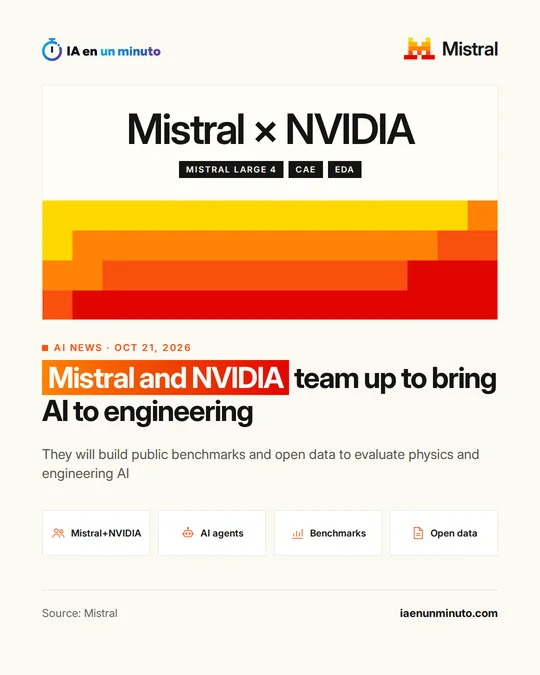
Mistral and NVIDIA collaborate to bring AI to industrial engineering with benchmarks and open data
IA en un minuto newsroom · Editor: Jon Elgezabal
In 30 seconds
Mistral will rely on NVIDIA computing so that its Mistral Large 4 model and its physics tools can make engineering simulations faster. The two companies will publish open tests and data to compare physics models and AI agents built for aerospace, automotive and semiconductors. The weights of Mistral Large 4, still in preview, are expected at the end of October.
Mistral and NVIDIA are expanding their collaboration to apply AI to industrial engineering. Mistral announced it on its blog on Wednesday, October 21.
The French lab will develop AI-native engineering workflows with NVIDIA that will run on NVIDIA's accelerated computing. To do so, it will bring together Mistral Large 4, its largest model, with its own data generation and physics modeling processes, backed by NVIDIA's CUDA-X and Warp libraries. The goal is to make engineering simulations faster and to link simulation, AI model development and design in a closed loop. The two companies will also integrate Mistral's models with NVIDIA's Omniverse libraries to generate 3D scenes and create simulation-ready objects (SimReady).
The central focus will be public benchmarks (reference tests) and open datasets for evaluating physics models. With them, researchers, developers and industrial teams will be able to compare the accuracy and performance of different models and validate automated processes that turn a CAD design into a simulation. They will also prepare specific tests for AI agents in computer-aided engineering (CAE) and electronic design automation (EDA), aimed at the aerospace industry, automotive and semiconductors. Those tests will measure whether agents know how to handle engineering tools, complete tasks with several steps and deliver technically correct results, as well as how long they take and how much computing they consume. According to Neil Ashton, Mistral's vice president of computational engineering, the pace of engineering has been dictated by the pace of simulation for too long.
The relationship between the two is not new. Together they developed Mistral NeMo, and they are now working within NVIDIA's Nemotron Coalition on a frontier base model with open weights. Mistral Large 4, released by Mistral in public preview, has roughly 1 trillion parameters in total and 49 billion active ones; it was trained on 3,800 NVIDIA Grace Blackwell GPUs in data centers that Mistral operates in Europe, and the company expects to release its weights at the end of October. Mistral is adding more NVIDIA-based infrastructure as part of its plan to reach 1 GW of computing capacity by 2030.
The announcement gives no dates for the benchmarks or the datasets, and does not say where they will be published.
Why it matters · analysis and opinion
Without a common yardstick, every result of AI in engineering is presented in its own way, and an industrial company struggles to compare before buying or trusting a design to an agent. A model lab and the leading provider of accelerated computing committing to publish open references could bring order to that conversation, as long as others adopt them and they do not become a showcase for their own products. Almost everything practical is still missing for real use: when they will come out, who will maintain them and whether they will include genuine design problems. Engineering teams already trying out agents can start recording what they measure today, such as time, cost and errors, so they can compare it once those tests are available.
Official source: Mistral · Written with the help of AI: how we make the news