IA en un minutoNewsBusiness and products
OpenAI models arrive on Google Cloud in private preview
IA en un minuto newsroom · Editor: Jon Elgezabal
In 30 seconds
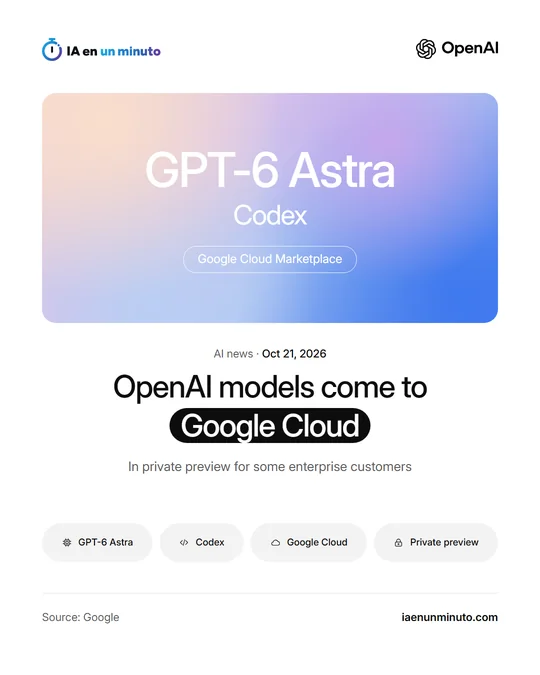
Google Cloud now offers GPT-6 Luna, GPT-6 Astra and GPT-6.1 Sol, from OpenAI, although for now only to a small group of enterprise customers. Codex can also be linked to the Gemini platform to work with those models. Spending is charged on the usual Google Cloud bill and counts toward the cloud commitments each company has signed.
Google Cloud has started offering three OpenAI models: GPT-6 Astra, GPT-6.1 Sol and GPT-6 Luna. Michael Gerstenhaber, vice president of Product for Gemini at Google Cloud, announced it on the company blog on Wednesday, October 21. For now they are in private preview and only for some selected enterprise customers, inside Model Garden, the Google Cloud model catalog, and Google says more will follow. Anyone who wants access can apply through a form.
In Google's description, GPT-6 Astra is the model for the most demanding work, such as programming, operating a computer, professional tasks and scientific research; GPT-6.1 Sol comes close to Astra at a lower cost, and GPT-6 Luna is the fast and inexpensive one, for everyday work at large scale. Since the day of the announcement, customers can use them through the Google Cloud APIs and connect Codex, the OpenAI coding agent, in its terminal and desktop versions, to the Google Gemini platform so the models run from there. Google plans to bring them later to Gemini for business and Google Antigravity as well.
Usage is paid through Google Cloud Marketplace, the Google Cloud store: it shows up on the same bill, is deducted from the cloud spending commitments the customer has already signed and counts toward its Flexible Savings Plans, the Google Cloud savings plans. Google says requests, context and answers stay within the data perimeter each customer sets and are not used to train models. The OpenAI models run on dedicated Google Cloud infrastructure; the option of keeping no data at all (Zero Data Retention) and confidential computing will come later. Google gives no prices or date for availability to all customers, and presents itself as the only major cloud provider with access to the three main closed language models, alongside more than 200 of its own, third-party and open models.
According to Reuters, which reports the deal as announced by both companies, OpenAI will bring its most recent models and Codex to Google Cloud in the coming weeks, and companies in regulated sectors will be able to use them with Google's access controls and data governance tools. The news agency notes that OpenAI and Google compete in AI products and search, and that last year Google had already closed a deal with OpenAI to give it more computing capacity in its cloud. It also points out that the exclusive distribution arrangement between OpenAI and Microsoft expired in April and that OpenAI has since expanded its distribution to Amazon Web Services, the Amazon cloud, and now to Google Cloud.
Why it matters · analysis and opinion
Two direct rivals ending up on the same shelf says a lot about how the market is settling: the model matters, but whoever controls the bill and the contract with the client company is the cloud. For OpenAI, joining the Google catalog opens the door to companies that already have their budget committed there and would hardly sign up a new supplier. For Google, adding its competitor strengthens its image as a neutral platform, even though its own models compete in the same shop window. What decides real use is still missing: prices, regions and when it will leave preview. Those already working with Google Cloud can request access and try it on a specific task before considering a change of supplier.
Official source: Google Cloud · Written with the help of AI: how we make the news
What does it mean for your business? · analysis and opinion
This mainly affects companies in Spain and Latin America that already work with Google Cloud and have a cloud spending commitment in place: they will be able to use OpenAI models and Codex by buying them through the Google Cloud store and drawing on that existing commitment, instead of contracting them separately. For anyone who uses ChatGPT on the web or the OpenAI API directly, or for freelancers with no cloud infrastructure, nothing changes for now. For now it is in private preview, only for some selected customers, and the news does not give prices or regions, so it is wise not to treat anything as available until it is active in Model Garden.
Our advice is to use the wait to check how much of the spending commitment is left and which projects could use it. The prudent approach is to compare, on a small real task, the results and cost of GPT-6 Astra against the models already in use, before moving anything into production. If Codex is being considered for the development team, it makes sense to start with a repository that holds no sensitive data.
For companies in regulated industries, the appeal is keeping the access controls and data governance they have already set up in Google Cloud. Even so, adding a new model means reviewing where personal data is processed and updating the record of processing activities and supplier contracts. The underlying risk is depending even more on a single cloud.