IA en un minutoNewsBusiness and products
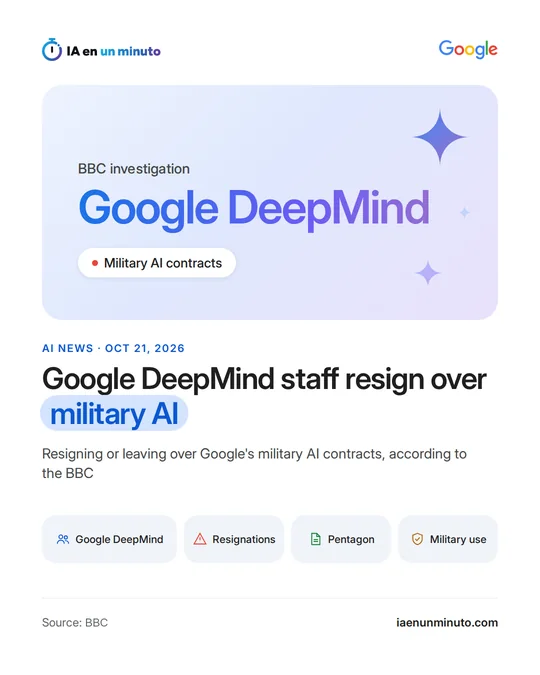
Several Google DeepMind employees resign over Google's military AI contracts, according to the BBC
IA en un minuto newsroom · Editor: Jon Elgezabal
In 30 seconds
A BBC investigation reports departures of Google DeepMind workers who object to the military use of Google's AI. Sofia Liguori left her job in London this week, and Andreas Kirsch left this month, convinced that Google's oversight falls short for that use. Google responds that it reviews these deals in line with its usage rules and its AI principles.
Several Google DeepMind workers have resigned or are about to leave over the company's military contracts, according to a BBC Eye investigation published on Wednesday, October 21.
One of them is Sofia Liguori, a research engineer in London, who left this week after three years at the company. She spoke to the BBC in a personal capacity, even though her contract restricts her from doing so, and said she is going because of Google's growing work with the US and Israeli militaries: seeing her employer back AI systems in military operations more and more makes her feel "ashamed" to work there. Researcher Andreas Kirsch also quit this month. He told the BBC he considers Google's governance and oversight not enough for using AI safely and responsibly in military and classified work, and that Google seems to have no say, and no veto, over what the Pentagon does with it.
Google is one of the tech firms that signed deals with the US military this year to bring AI into classified military environments; OpenAI, Amazon, Microsoft, SpaceX, Oracle, Nvidia and the start-up Reflection signed similar agreements. Google's deal allows its models to be used for "any lawful government purpose" and states that they should not be used for mass surveillance inside the country or for autonomous weapons, target selection included, without proper human oversight and control.
A Google spokesperson told the BBC the company has a consistent process for reviewing and signing these contracts, which includes checking them against its acceptable use policies and AI principles, and that staff have dedicated channels to raise concerns, backed by strict rules against any retaliation. Other current employees who spoke to the BBC without giving their names say staff are afraid to speak up because their contracts bar them from criticizing the company in public.
Why it matters · analysis and opinion
Several of the big AI tech companies have signed contracts with the US military this year, and the cost is starting to show inside the companies themselves. When the people leaving are engineers and researchers who joined for a specific mission, the problem stops being one of image and becomes one of talent. What those who leave point to is not only military use, but the lack of control: if the provider cannot veto or even see how its model is used, its ethical principles end up in the customer's hands. The same question applies, on a different scale, to any organization that buys AI: what usage terms its provider accepts with third parties and how much real room it has to enforce them.
Source: BBC · Written with the help of AI: how we make the news