IA en un minutoNewsBusiness and products
Bank of Spain: AI use has doubled among small and medium firms since 2024, but large companies remain far ahead
IA en un minuto newsroom · Editor: Jon Elgezabal
In 30 seconds
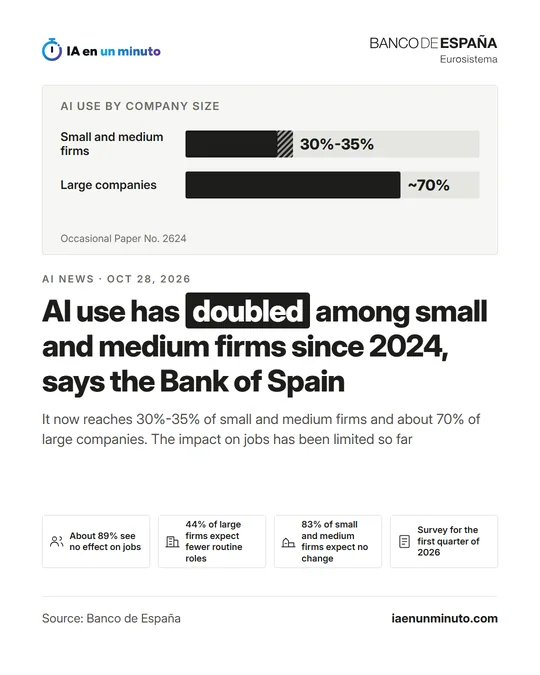
The Bank of Spain study measures how much companies in the country use AI: among small and medium firms the share is 30%-35%, and among large ones it runs at about 70%. The gap by size is still open, even though use among small and medium firms is roughly double what it was in 2024. On jobs, the vast majority of companies do not yet see significant effects.
The Bank of Spain has published Occasional Paper No. 2624, a study of how Spanish companies use artificial intelligence, according to its website and the paper itself as a PDF. The analysis starts from the AI module of its Business Activity Survey for the first quarter of 2026, sets it against the 2024 results and crosses it with data from company balance sheets to see what encourages or holds back adoption.
In the first quarter of 2026, between 30% and 35% of small and medium firms said they used predictive or generative AI, roughly double the 2024 figure (16 percentage points more). Among large companies, use has risen by about 17 points, to around 70%. According to the paper, the gap by size is similar to 2024, and small and medium firms mostly keep an experimental use.
The effect on jobs is, for now, limited. About 89% of companies answer that AI has had no significant effect on their number of workers over the last three years; about 6% would have reduced it and roughly another 6% would have increased it. Among those making heavy use of generative AI, around 13% would have expanded their workforce and about 10% would have cut it. These are companies' answers to a survey, not counts of layoffs.
Looking at the next three years, 44% of large companies expect roles built on repetitive or routine tasks to shrink, while 83% of small and medium firms expect no change in that kind of job. More analytical roles could benefit: about 20% of large companies expect increases in them.
The study adds that companies adopting AI have, on average, higher productivity, higher wages and more intangible assets. Among those that do not use it, the obstacles they cite most are a lack of resources and low perceived usefulness.
Why it matters · analysis and opinion
The study's value lies in crossing two sources: what companies answer in a survey and what their balance sheets show. That reveals that firms using AI also tend to be more productive and pay higher wages, although the document describes an association and does not prove by itself that one causes the other. For a small business, the useful reading is in the barriers cited by those that do not use it: lack of resources and little perceived usefulness. These are problems tackled by starting with one concrete, measurable use, rather than with a large investment. On jobs, the answers capture companies' perception of their workforce, not counted layoffs, and should be read that way. What is missing is following the trend with data from several years.
Official source: Banco de España · Written with the help of AI: how we make the news