Liquid AI launches LFM3, a family of six open models for audio and multimodal use on-device
IA en un minuto newsroom · Editor: Jon Elgezabal
In 30 seconds
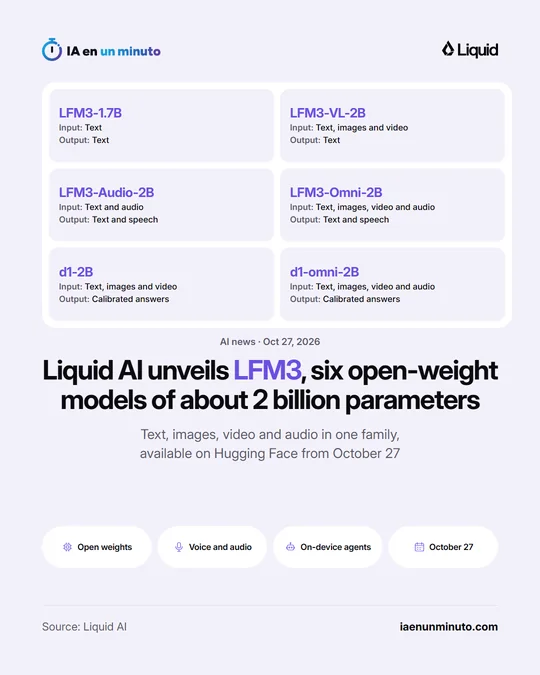
Liquid AI has released six open models working with audio, text, images and video that can run on a local machine. The text one, built for local agents, takes roughly 1 GB when compressed to 4 bits, the company says. There is also a voice model that translates across 18 languages and an omni one that understands every format and answers aloud.
Liquid AI, the company that builds AI models designed to run on any device, has introduced LFM3, a family of six open-weight models, meaning they can be downloaded and run on a machine of their own. It published them on October 27 on Hugging Face, the platform where models are shared, and, according to its blog post, each one can be tuned on its owner's data using a single GPU.
All six are around 2 billion parameters, the internal values a model adjusts as it trains, and all branch from the same text base, LFM3-1.7B-Base. LFM3-1.7B, the text model, is meant for local agents, that is, AI programs that chain steps and use tools on the user's own machine. According to Liquid AI, it improves on its predecessor LFM2.5-2.6B while using 35% fewer parameters, takes up about 1 GB in 4-bit form and offers a context window, the amount of text it can hold in mind at once, of 256,000 tokens, which are word fragments.
LFM3-Audio-2B takes text or voice and answers in text, in speech or in both. It can handle voice chat, speech recognition and synthesis, and translation across 18 languages. Compared with LFM2.5-Audio-1.5B, its earlier audio model, the company says it speaks with higher quality and gains the ability to understand audio and to call tools.
The first omni model from Liquid AI is LFM3-Omni-2B, which takes in text, images, video and audio and replies in text and speech. LFM3-VL-2B is the first of its vision models that accepts video.
The family is rounded out by d1-2B, which works with text, images and video, and d1-omni-2B, which adds audio. These two are given a situation, such as a customer's support ticket, plus a set of questions, and respond to the whole set in one go, attaching a probability to each answer. All figures and comparisons come from the company's own tests.
Why it matters · analysis and opinion
Open, small models move part of the voice and image work from cloud services to the user's own machine. For a small business or a professional with sensitive data, such as customer calls or meeting recordings, transcribing or translating locally avoids sending the audio to a third party. The trade-off is that someone has to install and maintain the model, and every comparison comes from Liquid AI's own tests, without outside verification. Anyone already paying for transcription or voice support can try the audio model on their own recordings and compare the result with their current provider's before deciding whether switching is worth it.
Official source: Liquid AI · Written with the help of AI: how we make the news