Wikimedia asks the court in the OpenAI and Microsoft case for chatbots not to reproduce text without a license
IA en un minuto newsroom · Editor: Jon Elgezabal
In 30 seconds
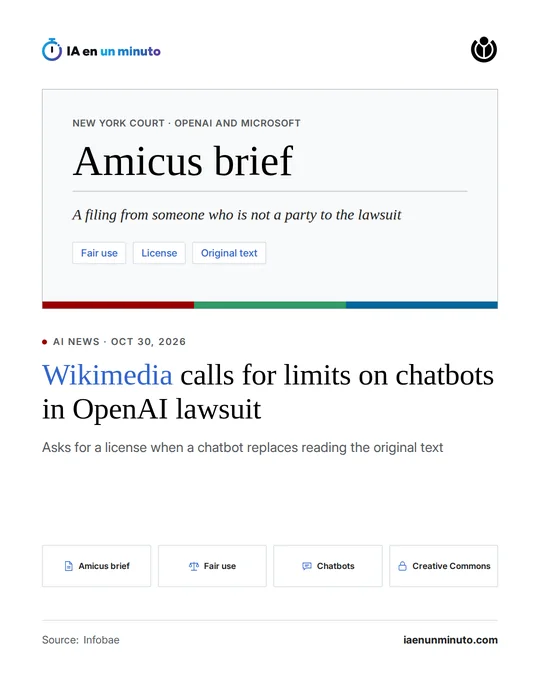
Wikimedia, the foundation behind Wikipedia, has sent a brief to the New York court judging OpenAI and Microsoft over training AI on news articles, without backing either side. Wikimedia argues that training models can count as fair use if it contributes something distinct, but wants a license if a chatbot pulls a text and ends up replacing the reading of the original. Judge Sidney Stein is now weighing the motions for summary judgment.
The Wikimedia Foundation, which runs Wikipedia, has stepped into the lawsuit pitting OpenAI and Microsoft against The New York Times without siding with either party. According to Infobae, it filed an amicus brief with the New York court, the document through which an outsider to the case offers arguments to the judge, in the case over the use of news articles to train AI.
Wikimedia warns, according to The Verge as cited by Infobae, that the positions of both camps lead to applying fair use in an "excessive and simplified" way. This is the doctrine that, in certain situations, lets people draw on protected works without authorization. The foundation proposes a middle ground: crawling data from websites would not be infringement, and training a model on protected works without a license would be legitimate if the result adds "something new and different". It does demand a license, however, if a chatbot retrieves a text and offers it in a way that leaves people no need to read the original. It also accuses services such as ChatGPT of spreading the encyclopedia's texts in breach of its free Creative Commons license, which requires citing the source and publishing any adaptation under the same license.
The case has drawn further interventions. According to Infobae, the US government filed a brief favoring OpenAI in September; this week the Association of American Publishers, which sides with the plaintiffs, and Professor Matthew Sag, who backs neither party, have entered. Judge Sidney Stein is examining the cross-motions for summary judgment. According to Sag, whatever he decides would be the first ruling from the Second Circuit on whether training models on books and articles is fair use, and the first in the world on the claims of news publishers.
Why it matters · analysis and opinion
This intervention matters not because it comes from one of the parties, but because of who signs it: an organization that lives on open content and complains about how it is reused. Its proposal separates two uses that are often mixed up: learning from texts, which it sees as acceptable, and serving their content as an answer, which requires complying with a license. For a company that publishes openly licensed content, or uses chatbots to generate text, the difference matters: reproducing fragments without citing the source could be a problem even if the model was trained lawfully. It remains to be seen whether the judge adopts that distinction in the ruling and what other courts would make of it.
Source: Infobae · Written with the help of AI: how we make the news