NVIDIA says AI agents now run the Allen Telescope Array radio telescope from a single request
IA en un minuto newsroom · Editor: Jon Elgezabal
In 30 seconds
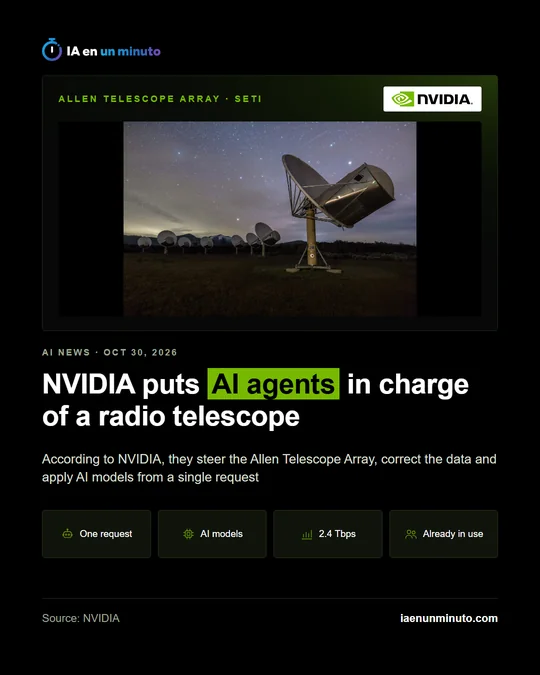
NVIDIA has put AI agents in charge of the Allen Telescope Array, an observatory in California, working with Breakthrough Listen and teams at the SETI Institute. According to NVIDIA, one request written in natural language is enough for the agents to point the antennas, fix the data and launch AI models, and the system can process 2.4 terabits per second. NVIDIA reports a pulsar spotted with AI in real time, not any extraterrestrial signal.
NVIDIA announced on Friday, October 30, that Breakthrough Listen and the SETI Institute are already using AI agents at the Allen Telescope Array, a radio telescope in northern California used to look for signals that might come from extraterrestrial sources. According to Crypto Briefing, the array has 42 antennas, and running it has traditionally demanded a lot of manual work: lining up the instruments, cleaning faulty data and deciding which analysis to run.
NVIDIA says that, starting from one request in natural language, the agents can aim the instrument, enhance and fix the data coming in, and run AI models on that stream. They are coordinated by Nexus, a web-based observatory orchestrator that gives them one source of truth on the state of the instrument, the computing resources and the analysis pipelines. Through it, researchers can also keep an eye on dropped packets, view spectrograms as they are produced and rewrite parts of the signal-processing chain. NVIDIA maintains that what would take a person weeks or years is handled this way in hours.
NVIDIA's Holoscan platform processes the sensor data. One of its libraries, DAQIRI, loads the data directly into GPU memory, which lets each observation be processed as it arrives instead of piling up on hard drives, and CyberEther, a signal-processing framework built at the SETI Institute, does the math with NVIDIA's CUDA-X libraries. The company puts the system's capacity at 2.4 terabits per second, running on NVIDIA RTX PRO 6000 Blackwell GPUs, and says the AI models execute on site, beside the instrument.
NVIDIA says this pipeline has already made the first detection of a pulsar in the Crab Nebula using AI in real time (a pulsar is the remnant of a star that spins very fast and sends out pulses like a lighthouse). It is a technical demonstration: according to TokenPost, the announcement does not claim that any extraterrestrial intelligence has been detected. Andrew Siemion, principal investigator of Breakthrough Listen, said that what these observatories find may resemble themselves more than the people who built them, but that it is nothing to fear: he described it as "a breakthrough in translation."
The team is now evaluating open models, NVIDIA Nemotron among them, for cases where data locality and fast turnaround matter most, and for observatories that could eventually operate without a connection on the Moon's far side.
Why it matters · analysis and opinion
More than the finding itself, this case shows a pattern: the agent stops being an assistant that answers questions and becomes the layer that operates a scientific instrument, with an orchestrator that gives it a single view of the equipment and its processes. The practical reason is the volume of data, which calls for processing it next to the instrument rather than storing it for later. Even so, the results come from NVIDIA itself and from a single project: the pulsar detection shows that the pipeline works, not that the method finds anything new. For any organization with massive data flows, the lesson is to first measure which repetitive tasks can be delegated and keep a person who verifies what the agent produces.
Official source: NVIDIA · Written with the help of AI: how we make the news