Google DeepMind Unveils Chemistry Skills for Antigravity Agents and Tests Them With Lung Cancer Drugs
IA en un minuto newsroom · Editor: Jon Elgezabal
In 30 seconds
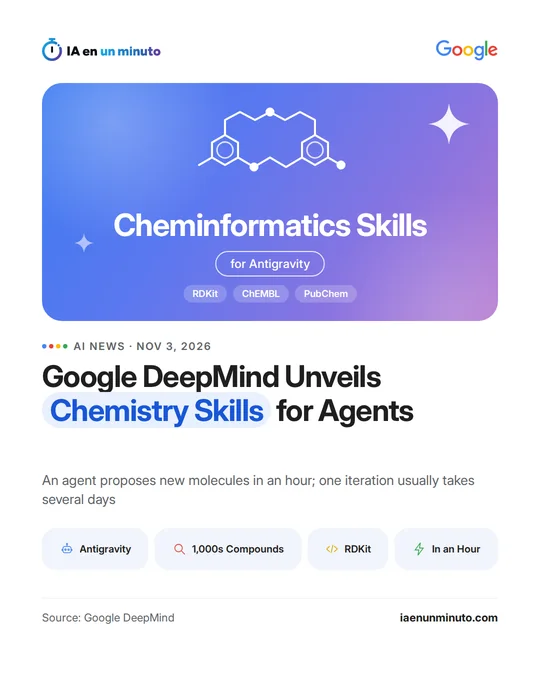
Antigravity, the Google agent environment, gains chemistry skills from Google DeepMind: the model coordinates and deterministic tools built on RDKit, ChEMBL and PubChem calculate. In the test, the agent collects thousands of compounds and designs more rigid macrocycles in an hour, against the several days each iteration tends to last. DeepMind reminds users that any proposal must be made and checked in the lab.
Google DeepMind has introduced Cheminformatics Skills, a package of chemistry capabilities for Antigravity, Google's agent platform. Its stated goal is for chemists to spend less of their time sorting data and more of it framing hypotheses.
The work is split in two. The language model plans the workflow, moves through the databases and reasons; deterministic chemistry tools handle the molecular math. Those tools rest on RDKit, an open source kit that an international community has been building for more than two decades, and they plug into the ChEMBL and PubChem databases. DeepMind points out that a paper may give a molecule its IUPAC name, a patent may draw it as a Markush structure and a catalog may store it in an SDF file, and that changing just one atom already describes another compound.
The demonstration starts from two real drugs for non-small cell lung cancer. Crizotinib is a first-generation tyrosine kinase inhibitor with five main rotatable bonds; lorlatinib, a third-generation drug, was cyclized at one end to bring the effective count of those bonds to zero and, among other effects, gained potency. Within minutes, the agent pulls thousands of compounds from the scientific literature and drops the irrelevant ones. It then compares pairs of molecules whose only difference is being cyclized or not, trains models that predict potency and proposes new, more rigid macrocycles, together with routes for making them. The whole process takes an hour; according to DeepMind, a single round of that work usually takes several days.
The skills can be used now: they are installed through the Science plugin of the Antigravity app, and companies can access them by signing in with their Google Cloud account. DeepMind is also giving 10,000 scientists Antigravity's top usage tier at no cost for six months, depending on eligibility, capacity and selection.
The team itself spells out the limits. Scarce data, noise between assays run in different labs and narrow measurement ranges cut into the models' precision, and each design the agent suggests still has to be synthesized and validated in the lab.
Why it matters · analysis and opinion
What matters is not that a model knows chemistry but the split: language coordinates and deterministic tools calculate, so a model's typical errors do not end up in the structure of a molecule. That design lowers the risk in a field where one misplaced atom changes the compound. Even so, the demonstration starts from a well-known success story, the step from crizotinib to lorlatinib, and does not show how many of the proposed molecules survive synthesis. For a small lab or a young chemistry company, the immediate value lies in saving the collection and cleaning of data, the most tedious part; the designs are hypotheses that an expert must prioritize before taking them to the bench.
Official source: Google DeepMind · Written with the help of AI: how we make the news