Google Launches Gemini Omni 1.2 Flash, Its Video Generation Model, With 15-Second Clips and a 30% Lower Price
IA en un minuto newsroom · Editor: Jon Elgezabal
In 30 seconds
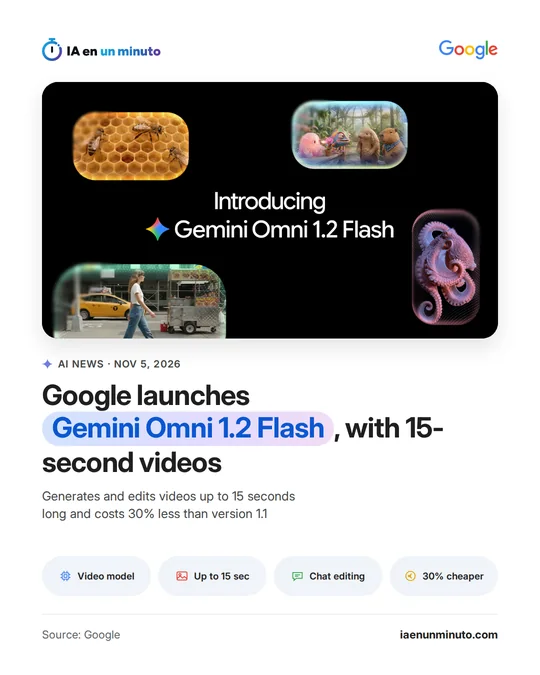
Gemini Omni 1.2 Flash, Google's new video model, stretches clips to 15 seconds and lets people retouch them inside a conversation without starting from scratch. Google says it holds on to faces, clothing and brand colors throughout the whole video, with more natural dialogue and better lip-sync. Gemini for business and the Gemini API already offer it at $0.07 per second in 720p.
Google launched Gemini Omni 1.2 Flash on November 5, the new version of its model for creating and editing video, and made it generally available in the Gemini API and in Gemini for business, its offering for companies. It is the first time a Gemini Omni model has reached general availability, with Google Cloud infrastructure and security behind it.
Videos can now run up to 15 seconds, compared with 10 in Omni 1.1, and the length is picked second by second between 3 and 15. As references it accepts images of characters, products or styles, short motion clips (three seconds at most) and sound cues, and Google says it keeps faces, clothing, the lettering on packaging and brand colors steady from beginning to end, including across camera changes. Google also says dialogue sounds more natural, lip-sync is clearer and the model tells several speaking characters apart better.
The other new feature is turn-by-turn editing in a conversation: on the same clip, users can change a product or the background, the lighting or the weather, or the aspect ratio, without generating it again. It works on full 15-second clips.
The price drops 30% from Omni 1.1, to $0.07 per second of video in 720p. Google suggests drafting in 360p or 720p, fixing details with edits instead of regenerating, and moving only the best results up to 1080p or 4K. Videos carry an invisible SynthID watermark, and companies can reserve capacity with Provisioned Throughput.
The model is also coming to other Google products: Flow; Google Vids, where 15-second clips carry no extra cost with a Google account or a Google Workspace subscription; the Gemini app, where Google AI Ultra subscribers are starting to get it; and Google Ads. Google acknowledges it is still working to improve scenes such as fast sports action, quick script changes and complex physics.
Why it matters · analysis and opinion
The leap lies less in the length than in the way of working. Until now, touching up a detail in a generated video meant asking for it again and hoping for the best; being able to fix it piece by piece brings these tools closer to a real production workflow, where a piece is iterated on instead of thrown away. For marketing teams and shops that need many variants of the same ad, that weighs more than any quality improvement. Google selling it with its cloud infrastructure and a watermark is also a signal: generated video is moving into the territory of enterprise contracts. It remains to be seen how well it holds up in scenes with a lot of movement, which the company itself admits is a weak spot.
Official source: Google · Written with the help of AI: how we make the news
What does it mean for your business? · analysis and opinion
This update matters most to small businesses, freelancers and online stores in Spain and Latin America that already prepare short videos for social media, ads or product pages, and to anyone working with the Gemini API or with Gemini for business. If you do not produce video, or you outsource it to a production company, you do not need to change anything for now. Google positions it for very specific uses: virtual clothing try-ons, rotating catalog views and ads with the brand colors, starting from photos the company already has.
Our advice is to test it with a small case before bringing it into daily work. The workflow Google describes itself helps cut costs: making drafts in 360p or 720p, fixing details with an edit in the conversation instead of generating the whole clip again, and only upscaling to 1080p or 4K the ones that will really be published. It is also worth choosing just the right duration, since it can be set second by second between 3 and 15.
The cost is measured per second of video ($0.07 in 720p), so it is wise to set a spending cap and review usage during the first weeks. In addition, if photos of real people are used as a reference, it is sensible to get their permission in writing and review each clip before publishing it, because the company is the one responsible for the result.