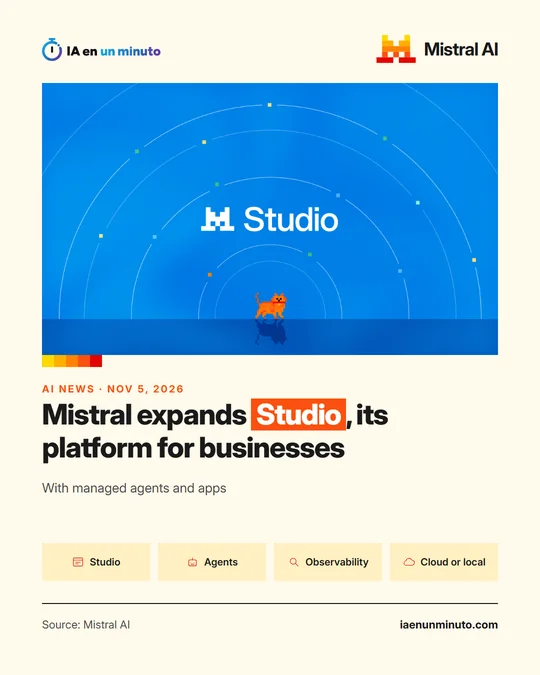
Mistral AI Expands Studio, Its AI Platform for Businesses, With Managed Agents and Apps
IA en un minuto newsroom · Editor: Jon Elgezabal
In 30 seconds
Mistral AI is adding to Studio agents that work through long jobs step by step and apps ready for an organization's daily routine. Studio also lets teams follow every step of a run and try changes on their own data before they go live. ABANCA, BNP Paribas and Capgemini are among those already running it in production, and the platform supports the cloud, a VPC or a company's own servers.
Mistral AI has expanded Studio, its AI platform for businesses, with managed agents and apps. The update, announced on November 5, also brings changes for workflows, enterprise context, observability and agent evaluation.
According to the company, managed agents handle complex jobs that take several steps. Developers can give them skills that record how their team does things, isolated environments for running code and subagents to hand parts of the work to, and can set which tools, data and actions they are allowed to reach. Studio runs them on the same infrastructure that, Mistral says, handles millions of sessions of Mistral Vibe, its coding agent, every week.
Workflows define which parts of a process run on fixed rules, which ones an agent reasons through and at what point a person makes the call, and a run that gets cut off can pick up where it stopped. This release adds triggers fired by events in company systems and a graph that lays out the logic of each workflow. Apps, for their part, come with hosting, authentication and access controls, and are published with a single command under a link of their own or inside Mistral Vibe. For developers, Mistral is launching an MCP server for working from Vibe or another coding agent, testing locally and deploying to Studio.
The platform and the models can be installed in a company's own cloud, in a virtual private cloud (VPC) or on its servers; customers can also use the deployment Mistral hosts or mix environments. OpenTelemetry traces display every step of a run, from model calls to tool use and approvals, and evaluations let teams try out new prompts, models or tools on the customer's own data before putting them live.
Mistral says customers and partners such as Tata Consultancy Services, Capgemini, BNP Paribas, ABANCA, Accenture, CMA CGM and Alten already run Studio in production. It also gives examples from inside the company: an agent that looks into production incidents saves its engineering team hundreds of hours a month, and a workflow that sorts ideas and customer feedback saves its product operations team roughly 35 hours a week.
One of the models a company can start with in Studio is Mistral Large 4, which Mistral calls Le Chonk and which, according to the company, excels at coding, defensive cybersecurity and reasoning over complex documents. Mistral unveiled it as a preview in October, when The Register described it as a one-trillion-parameter model and the largest the company had released with open weights, and it published those weights on October 29, according to its official page. The Studio announcement gives no prices for the new features.
Why it matters · analysis and opinion
Competition among enterprise AI providers is shifting from the model to everything around it: where it runs, what permissions it has, what trail it leaves and how it is evaluated. With this expansion, Mistral brings those pieces together in a single platform and lets customers choose where it is installed, which matters in sectors such as banking or logistics, where sensitive data should not leave the building. The company is thus returning to its two banners, open models and full control for each customer. The list of users it cites is made up of large groups and consultancies with their own technical teams; what remains unknown is how much it costs and how much effort it takes to get it running in smaller organizations.
Official source: Mistral AI · Written with the help of AI: how we make the news
What does it mean for your business? · analysis and opinion
This development is especially relevant for businesses in Spain and Latin America that already have a technical team, whether in-house or outsourced, and want to build agents or automate internal processes without depending on a single provider. The fact that Studio can be deployed in the cloud, in a company's own private cloud, or on the company's own servers matters for anyone who handles sensitive customer data. For a freelancer or a small business that only uses a chat assistant to draft text, this changes little in day-to-day work: Studio is a platform for building custom systems, not a ready-to-use application.
Our advice is to start with a single, specific, measurable process, such as sorting emails or reviewing repetitive documents, and to test it before expanding further. It is worth relying on the agent observability and evaluation features that Mistral announces to check what each agent does before giving it access to real systems, and to connect it only to the data it needs.
The announcement does not give prices, so the sensible approach is to request a quote and compare before making a commitment. Deploying on the company's own premises gives more control over data, but it requires staff and maintenance that not every small business can take on. That hidden cost is what weighs most heavily on the decision.