Apple Opens Siri AI to Third-Party Apps, for Now in Beta for Developers
IA en un minuto newsroom · Editor: Jon Elgezabal
In 30 seconds
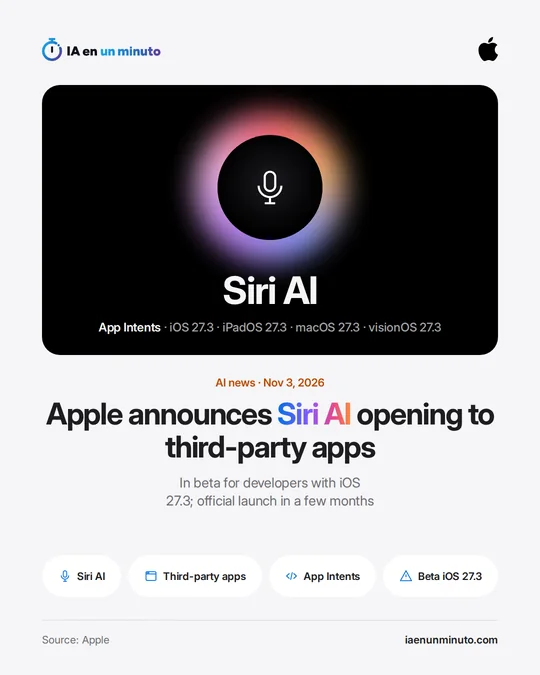
Siri AI, the revamped Apple assistant, now accepts apps from any developer through App Intents, for now only in the 27.3 betas. Apple expects users to get it within a few months and the App Store to accept these apps from the spring. Siri AI speaks Spanish, although on iOS, iPadOS and watchOS it has still not reached the European Union.
Apple has opened Siri AI, the new version of its assistant, to apps from any developer. Since Tuesday, November 3, a developer preview bundled with the 27.3 betas of iOS, iPadOS, macOS and visionOS lets any app be connected to the assistant.
The connection goes through App Intents, the framework an app uses to hand its content and actions over to Siri AI. That way, apps can tap the assistant's newest features, such as its grasp of personal context, its awareness of what is on screen and natural language: users ask for things in their own words and Siri AI carries out the actions the developer has built, anything from tracking a delivery to reserving a table or ordering something. For more complex requests, Apple is adding skills that chain several actions into a single experience.
Apple has already started bringing these capabilities to many of its own apps, such as Notes, Mail, Calendar, Photos, Maps and Safari. Siri AI works in several languages, among them Spanish, English, French, Japanese, Korean and Portuguese, and will soon add Norwegian, Turkish, Vietnamese and Traditional Chinese.
For now this is early access for developers: Apple expects it to reach users within a few months and will open App Store submissions in the spring. It also notes that Siri AI is not offered for now in the European Union on iOS, iPadOS or watchOS, that people under 13 cannot use it and that some features relying on server-side models have daily usage caps, which can be raised later for a fee. The company will share more details about the terms and usage policies.
Why it matters · analysis and opinion
For businesses with their own app, the Apple assistant stops being territory reserved for a few functions and becomes a front door: if a customer can ask out loud for an order or a booking, an app that is not integrated will be left out of that conversation. The timeline leaves room to prepare, because the first tests arrive months before the public gets it. Still pending is what Apple has not yet explained, such as the terms and usage policies, which may shape what is allowed. For European users there is an added complication: as long as Siri AI stays out of the European Union on phones and tablets, they will not be able to benefit from these integrations.
Official source: Apple · Written with the help of AI: how we make the news
What does it mean for your business? · analysis and opinion
This development is especially relevant for businesses in Spain and Latin America that have their own app for iPhone, iPad, or Mac, such as stores, booking services, or academies, and for studios and freelancers who develop apps for others. Those without their own app do not need to do anything for now. A useful detail for this audience: the assistant already works in several languages, including Spanish and Portuguese. There is an important caveat for Spain, though: Apple says Siri AI is currently unavailable in the European Union on iOS, iPadOS, and watchOS, so Spanish customers will not be able to use these integrations on their phones while that remains the case.
In practice, our advice is to ask whoever maintains the app to check which actions it already exposes through App Intents, and to choose two or three of the most common ones (checking an order, booking an appointment, repeating a purchase) to test first. These tests should be done on a test device with the 27.3 beta versions, never on a work phone. There is time: Apple will open the App Store submission period in spring, and the official launch is expected in a few months.
The main cost is development hours, and the risk is investing them in something that is still a preview and may change before its final version. The prudent approach is not to promise this feature to customers until it is available to everyone. In addition, since the assistant uses the user's personal context and what appears on screen, it is worth reviewing which app data remain accessible through these actions and explaining it clearly in the privacy policy.