OpenAI Says GPT-6 Astra, One of Its AI Models, Designed a Physical Device in Under a Week
IA en un minuto newsroom · Editor: Jon Elgezabal
In 30 seconds
OpenAI credits GPT-6 Astra with designing a voice device for chatting with Codex, a side project two people finished in under a week. Astra handled the look, the enclosure, the electronics, the board and the firmware, but overlooked manufacturing limits and forced several rounds of review. BenchCAD 2.0 puts a later internal model ahead of Astra at rebuilding 3D parts.
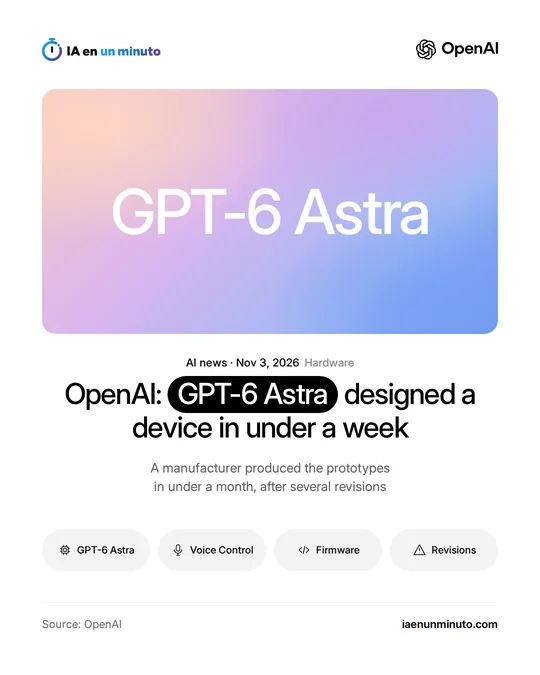
On November 3, OpenAI published an article on how its models help design, simulate and build physical products. Its main example is a gadget for talking to Codex, the company's coding agent, by voice, which OpenAI says was designed with GPT-6 Astra in under a week.
The aim was to see whether a device could be created without anyone editing the design directly. According to OpenAI, GPT-6 set the functional requirements, while Astra took care of the device's look, the enclosure and the internal parts that hold everything in place, the choice of electronic components, the printed circuit board layout, the interface, and the firmware and integrations needed to link it to Codex. Two people on the team built it as a side project, and a contract manufacturer turned out a small run of prototypes in under a month.
OpenAI itself admits that getting it ready for manufacturing took several rounds of review, because Astra did not always factor in the manufacturer's production limits, the tolerances or certain assembly details. The company describes it as a test device, and Diario TI notes that nothing published suggests it will be sold.
The article adds that OpenAI's hardware teams have increased their use of the models 23-fold since February, measured in tokens. On BenchCAD 2.0, a test of whether a model can rebuild 3D parts and assemblies and spot connections on circuit boards, a newer internal model averaged 0.875, while GPT-6 Astra, on its top reasoning setting, scored 0.594. OpenAI is also extending its work with the Chip Ganassi Racing motorsport team and announcing a research collaboration with Mazda to study vehicle designs.
Why it matters · analysis and opinion
A model that chains together the mechanical design, electronics and software of a device goes a step beyond writing code, because it has to coordinate disciplines that companies usually split across several teams. OpenAI's own account, however, shows where the limit lies: what separates a prototype from a manufacturable product is precisely the details Astra overlooked, and that is where human judgment was still needed. It should also be read for what it is: a case told by the very company that develops the model. For engineering studios and small manufacturers, the practical message is that these tools can shorten the idea and first-design stage, but they do not replace the review of someone who knows the factory.
Official source: OpenAI · Written with the help of AI: how we make the news