Anthropic uses Claude to obtain the first 3D structure of a vault particle in prokaryotic cells
IA en un minuto newsroom · Editor: Jon Elgezabal
In 30 seconds
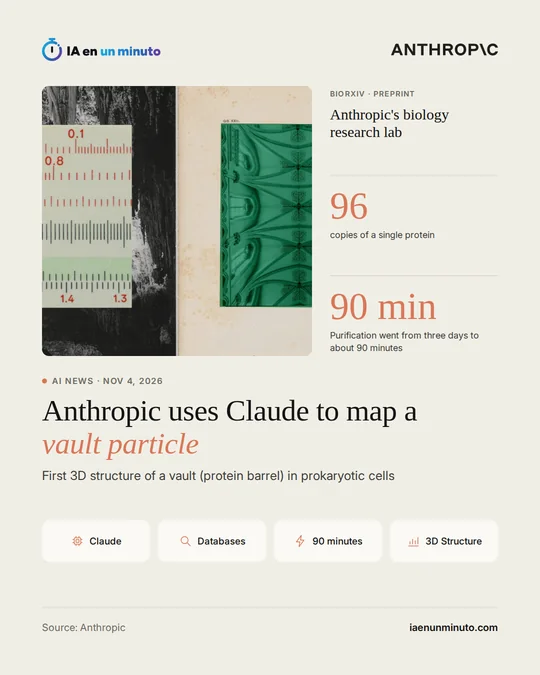
Claude, the AI model from Anthropic, was involved from start to finish in the work that produced the first 3D picture of a vault from prokaryotic cells. The particle comes from a bacteriophage and gathers 96 copies of one protein, against 78 in the mammalian version. Anthropic says isolating it took about 90 minutes instead of roughly three days, and the results sit in a bioRxiv preprint.
On Wednesday, November 4, Anthropic's biology research lab unveiled the first 3D structure of a vault particle obtained in prokaryotic cells, the group that bacteria belong to. Its AI model, Claude, took part in every stage of the work, always under the team's direction.
Vaults are huge hollow barrels of protein that turn up in almost every cell of the human body. They were discovered in 1986 and are named for their shape, which reminded the scientists who found them of a cathedral's vaulted ceiling. Four decades later, nobody yet knows what they are for. Related proteins were already known in the genomes of bacteria and of bacteriophages, the viruses that infect bacteria, but according to Anthropic nobody had shown that they actually come together into vaults.
The one the team solved comes from a bacteriophage. It is made of 96 copies of a single protein, where the mammalian kind has 78, and it is shorter and wider than the human one. Claude combed a database of some 15 billion predicted proteins, drew up the DNA design for each candidate, helped fine-tune the isolation method and processed the cryo-electron microscopy images. Purification, which takes roughly three days with the usual method, came down to about 90 minutes, and the first model of the structure was ready within 34 hours.
Anthropic also lists the setbacks: a protocol written by Claude delayed the project by two weeks, and early in the processing it skipped a routine step that had to be fixed. The results are in a preprint submitted to bioRxiv. So far these vaults have only been produced in the lab inside the bacterium E. coli, and their function remains a puzzle.
Why it matters · analysis and opinion
What stands out is not just the finding but who made it: a team that, by Anthropic's own account, had limited experience in structural biology and filled the gaps with the model. That suggests AI can lower the barrier to entry in highly specialized fields, which matters to small labs and biotech companies. The account also shows the limits: Claude's mistakes cost the most time exactly where the team knew least, which is where people tend to trust the machine most. Other scientists still have to review the preprint and other labs have to repeat the method. And it is worth reading for what it is: a company's demonstration of its own product, useful but not independent.
Official source: Anthropic · Written with the help of AI: how we make the news