Google will turn off Gemini and its search engine by default for school students
IA en un minuto newsroom · Editor: Jon Elgezabal
In 30 seconds
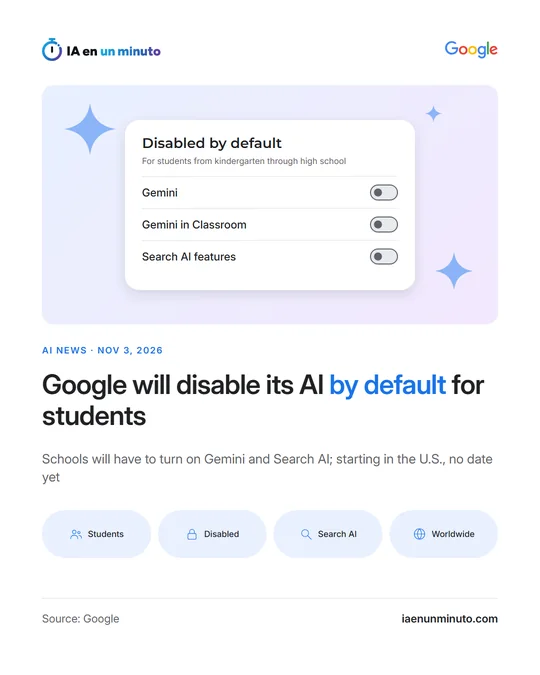
Google will ship its AI tools switched off, Search included, on school accounts, and each school will choose whether to turn them on. Phillips admits that a school that bans all AI will leave its students without a search engine. The United States will be the first country to get the change, which still has no date and will then spread worldwide.
Google is reversing course on AI in the classroom. On Tuesday, November 3, it announced on its blog that Gemini, Gemini Notebook, Gemini in Classroom (its platform for running classes) and Google Search will be switched off by default on the accounts of students from kindergarten to high school, until the school's administrators decide to enable them. The company frames the move as the result of its conversations with schools, teachers, researchers and policymakers.
Google told AFP, in a report carried by TradingView, that the setting will reach every country, beginning with the United States, although there is no date for it yet. TechCrunch places it next year, and Chris Phillips, Google's vice president for education, wrote that the company will give schools more details in the coming months so they have time to get ready.
There is an important catch: search and AI no longer come apart. Phillips told The New York Times, as reported by TechCrunch and AFP, that the two are "deeply integrated". So if a school bans all AI, its students will lose search as well and will see a notice from the school saying it is not available.
The change follows months of criticism from parents, schools and public officials, AFP notes. In August, Google had opened Gemini in Classroom to students of any age, and it came switched on in schools that already allowed Gemini; that setting is now being reversed. Last month, senators Richard Blumenthal and Josh Hawley, who put the number of students using Classroom worldwide at more than 150 million, asked the company for answers, and in September New York and Los Angeles announced they would limit AI tools on school devices.
In the same announcement, Google rolled out its Guided Learning feature in Classroom worldwide, which walks students through a problem step by step instead of handing them the answer, and it is preparing a pilot in Search with some US schools this month.
Why it matters · analysis and opinion
Putting the decision in each school's hands is a real shift: until now some of this AI arrived switched on and it was up to the school to turn it off. But that freedom comes with fine print. Since the search engine now carries AI inside it, anyone who wants to do without it will also have to give up their usual search tool, and that tilts the balance toward accepting it. For school leaders, the practical step is to check now which Google services are enabled on their students' accounts, agree with teachers on what use they want to allow and wait for the promised details before the change arrives. For the rest of the sector, the takeaway is clear: pressure from families and public authorities does move big tech companies.
Source: TechCrunch · Written with the help of AI: how we make the news
What does it mean for your business? · analysis and opinion
This change affects schools in Spain and Latin America that work with Google's educational tools, such as Google Classroom or Chromebook laptops, with student accounts from kindergarten to high school. It does not affect business or personal accounts: Google has only talked about student accounts, and it has not said that the measure extends to staff accounts.
Our advice is not to wait until the last minute. The school's IT manager should take stock now of which student accounts exist and which services they use, and school leadership should decide, product by product, what it wants to enable before the change arrives, which TechCrunch places next year. If a school chooses AI, the sensible approach is to start with Guided Learning, the more structured mode, and explain the decision to families in writing, alongside the authorizations the school already has signed.
The main risk is organizational: since Google has not given an exact date, the change could arrive in the middle of the school year, and a school that has not decided anything could find its students without search in the middle of class. Rejecting AI also has a practical cost, because it forces schools to find another way for students to do their searches online.