IA en un minutoNewsBusiness and products
Shield AI to buy Echodyne for $5.3 billion as its valuation reaches $28.8 billion
IA en un minuto newsroom · Editor: Jon Elgezabal
In 30 seconds
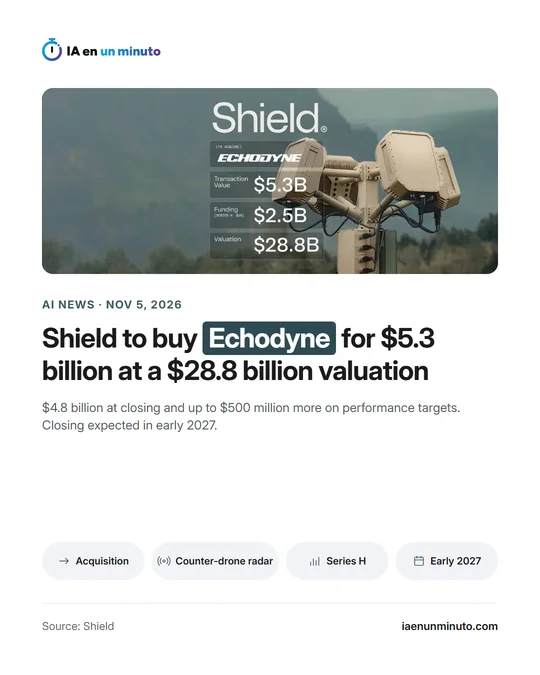
Shield is taking over Echodyne, the maker of radars used to spot drones, in a deal worth $5.3 billion. To fund it, the company is pulling together $2.5 billion from debt arranged by JPMorgan Chase, money from Blackstone funds and a Series H that puts Shield at $28.8 billion. Echodyne keeps its team and its MESA radars, and closing is planned for early 2027.
On November 5, Shield (Shield AI), a defense technology company founded in 2015, announced a definitive agreement to take over Echodyne, a radar designer and manufacturer based in Kirkland, Washington. The deal is valued at $5.3 billion. At closing, Shield will pay and issue $4.8 billion of that amount; up to another $500 million hinges on Echodyne hitting performance targets agreed by the two sides.
Echodyne builds compact solid-state radars on a patented technology it calls MESA (Metamaterials Electronically Scanned Array). Its sensors sit inside hundreds of security and counter-drone systems, whose users include government, commercial and military customers across more than 40 countries. They are mounted on high-energy lasers, remote weapon stations and high-power microwave systems, and they guide interceptors toward approaching drones. In civilian settings they guard airports and stadiums against unauthorized drones and allow fire and police departments to fly drones safely where the airspace is shared. In September, Echodyne won a contract from Joint Interagency Task Force 401, with a ceiling of $250 million, to provide counter-drone radar to the forces of the United States and its allies. It also recently opened a factory in Kirkland covering 86,350 square feet, a $40 million investment that will be able to turn out roughly 30,000 radars a year.
With the purchase, Shield expands its mission systems division, which takes on software-defined radars for counter-unmanned aircraft systems, the kind that detect, track and defeat drones. Its existing lineup includes two autonomous systems, V-BAT and X-BAT, the Hivemind autonomy software and Aechelon, a simulation product for training and testing. According to the announcement, both companies expect their revenue to grow at a triple-digit pace, that is, 100% or more, this fiscal year.
To pay for the deal, Shield is gathering $2.5 billion from three sources: $500 million in debt, with JPMorgan Chase Bank as the sole arranger of the financing; $1 billion in structured equity put up by Blackstone-managed funds; and $1 billion from a Series H round that values the company at $28.8 billion once the money is in. Disruptive and Innovation X Capital co-lead the Series H, joined by Center15 Capital, Apandion, Snowpoint Ventures, Advent and the Strategic Investment Group of JPMorganChase's Security and Resiliency Initiative, among others. Most of the money from that round will go to the acquisition.
After closing, Echodyne will carry on with its strategy of selling radars to end customers and integrators across defense, government and business. Its staff stays, MESA radars will still be sold as standalone products, and its chief executive, Eben Frankenberg, will answer directly to Shield's chief executive, Gary Steele, while remaining in charge of products, manufacturing and relations with partners and customers. In Steele's words, the purchase sharply speeds up Shield's efforts to meet demand for multi-mission capabilities and gives it more access to the counter-drone business, which is growing fast. Frankenberg, for his part, says Shield shares his belief that an autonomous system can act only on what it is able to detect.
The two companies expect the deal to close in early 2027, once regulators give their approval and the other customary conditions are met. The announcement gives no revenue figures for either company and does not say what Shield was worth before this round.
Why it matters · analysis and opinion
The deal confirms where defense money is heading: toward whoever brings together the sensors and the software that makes the decisions. Shield already had autonomy software and autonomous systems; with Echodyne it adds the piece that sees the threat coming, and Echodyne's chief sums it up in a simple idea: an autonomous system only acts on what it detects. The fact that the financing combines an equity round, structured money from a major asset manager and bank debt shows that investors now treat these companies as established industrial players rather than bets. It remains to be seen what regulators say and whether Echodyne keeps the trust of integrators that compete with its new owner. For anyone who makes or integrates civilian surveillance technology, such as for airports or stadiums, the signal is clear: detecting drones is now a market in its own right.
Official source: Shield · Written with the help of AI: how we make the news