Thousands of people protest in Zaragoza against data centers
IA en un minuto newsroom · Editor: Jon Elgezabal
In 30 seconds
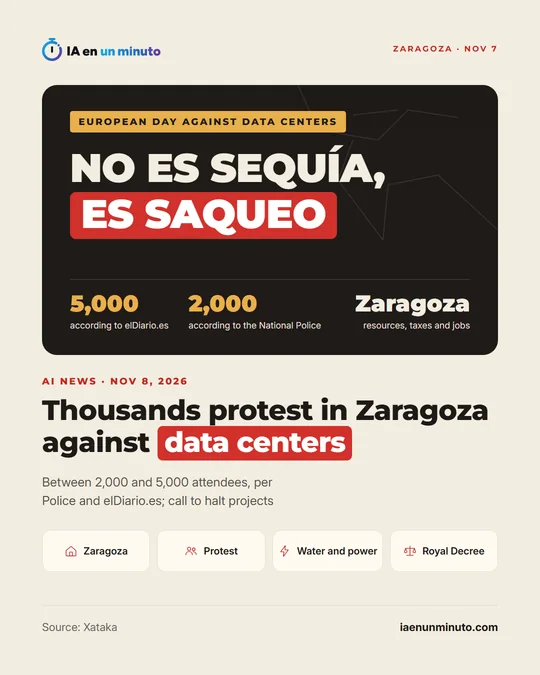
Zaragoza saw a march against data centers on November 7 that drew about 5,000 people according to elDiario.es and 2,000 according to the Spanish National Police. No es sequía, es saqueo, one of the organizers, wants work underway stopped until its effect on water, power, taxes and jobs is clear. Aragon expects 34 centers, according to Pedro Santisteve, and the draft Royal Decree that will regulate them has been softened under industry pressure.
On Saturday, November 7, the European Day Against Data Centers, thousands of people marched through Zaragoza in protest at these facilities, the ones that keep artificial intelligence running. The count depends on who does it: elDiario.es puts the crowd at about 5,000 and the Spanish National Police at 2,000. Xataka notes that Aragon has become the favorite destination for data centers in Spain.
The platform "No es sequía, es saqueo" ("It is not drought, it is plunder"), along with other groups, is demanding that projects already being built be stopped while their impact is studied. Chants heard at the march included "No hay agua para tanto dato" ("There is not enough water for so much data") and "Queremos pisos baratos, no centros de datos" ("We want cheap housing, not data centers"). Cristina García, an industrial engineer and member of the collective, put it this way: "These projects do not create jobs, do not pay taxes and are taking all the resources".
The criticism focuses on water, electricity, taxes and jobs. According to the groups, more than a thousand jobs were promised, but, setting construction aside, the centers already running employ barely 200 people. Speaking to elDiario.es, as reported by Xataka, former Zaragoza mayor Pedro Santisteve attacked Aragon's Projects of General Interest, which in his view smooth the way for big companies through tax exemptions, expropriations and fast-tracked permits, and put the number of centers planned in the region at 34. Pedro Arrojo, UN rapporteur on water and professor emeritus at the University of Zaragoza, told the same paper that his proposal is not to ban the sector but to understand it properly and set rules for it; he also warned that it is unclear who will get priority over water during droughts, and that upgrading the power grid will end up on consumers' bills.
On taxes, a few weeks ago there was controversy in El Burgo de Ebro and Villanueva de Gállego because the local business tax on the Amazon Web Services centers was going to be paid in Madrid; Amazon later clarified that it would stay in Aragon.
Consumption is the other worry. The International Energy Agency expects electricity demand from data centers to double and reach 945 TWh in 2030, more than all of Japan uses today. In Aragon, according to the newspaper Ara, consumption would rise from 10,000 to more than 55,000 GWh a year if every announced project went ahead.
The protest comes as Spain works on a Royal Decree on data centers. The draft, presented in August, required newly built renewable energy and top efficiency in the use of energy and water, but it has been watered down after pressure from the industry: it would only apply from 10 MW, rather than 1 MW, and operators that fall short of 80% renewables would get up to five years to adapt.
Why it matters · analysis and opinion
AI infrastructure is no longer invisible to the people who live next to it. Until now, the debate in Aragon revolved around how to attract these investments with fast-tracked permits and tax breaks; now some residents are asking what they get in return for the water, electricity and land these facilities take up. That question has consequences: a project that does not explain how much it consumes, how many stable jobs it creates and where it pays tax risks delays and losing political support. For companies that rely on the cloud, the warning is indirect but real: computing capacity close to home will also depend on local acceptance. What is missing, and what even the most moderate voices are asking for, is public, verified information, so the debate is not fought blind.
Source: Xataka · Written with the help of AI: how we make the news