New Matrix, approved for NVIDIA's H200 chips, has an empty office, The New York Times reports
IA en un minuto newsroom · Editor: Jon Elgezabal
In 30 seconds
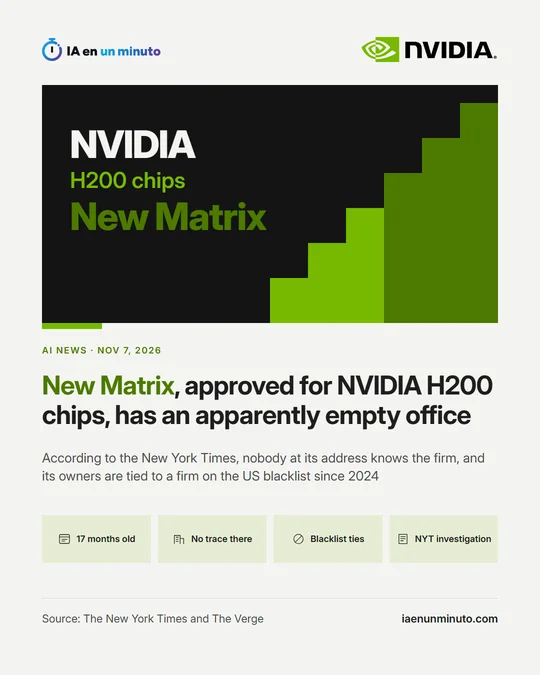
New Matrix is one of the Chinese firms allowed to work with NVIDIA's H200, yet The New York Times found its office empty. The company is 17 months old, its building's directory leaves it out, and its owners have ties to a Chinese private equity firm on the US blacklist since 2024. The Verge reports doubts about how NVIDIA and the Commerce Department vet who gets approval.
An investigation by The New York Times, published on Saturday, November 7, and picked up the same day by The Verge, says that New Matrix, one of the Chinese companies cleared to handle NVIDIA's H200 AI chips, has an empty office. The paper portrays a bare gray space with loose cables in place of ceiling lights.
There is hardly any public information about the company, which was set up 17 months ago. The building it gives as its address does not mention it in its directory, and at the industrial park's property manager nearby, a receptionist and a manager told the Times the company was not on their records.
According to the paper, New Matrix's owners have links to a private equity firm from China that has been on the US government's blacklist since 2024. The Times adds that this is not an isolated slip but a pattern: companies connected to entities under trade restrictions for national security reasons have obtained permission to buy NVIDIA chips.
The Verge recalls that under the Biden presidency NVIDIA faced restrictions on selling chips to China. The Trump administration loosened those limits after the company agreed to hand over 15% of all sales to the government, and its CEO, Jensen Huang, ran an intense lobbying campaign.
According to The Verge, doubts are being raised over whether the Commerce Department and NVIDIA check carefully enough the Chinese companies that get the green light to handle the H200. The article includes no response from either of them and does not say whether New Matrix has actually received any chips.
Why it matters · analysis and opinion
The case points to the weakest link in export controls: knowing who is behind each buyer. A list of approved companies only protects anything if someone checks that they exist and who owns them; if a recently created firm with no visible activity can get onto it, the restriction loses much of its point. For NVIDIA the problem is twofold, because its sales in China depend on permission from the US government and now its own customer checks are also being questioned. If the Commerce Department tightens its reviews, approvals may come more slowly. Anyone who buys, resells or distributes AI hardware would do well to document their customers and the final destination of each shipment carefully, since they are likely to be asked to prove it in more detail.
Source: The Verge · Written with the help of AI: how we make the news