China will require an identity code for AI agents preinstalled on phones and watches
IA en un minuto newsroom · Editor: Jon Elgezabal
In 30 seconds
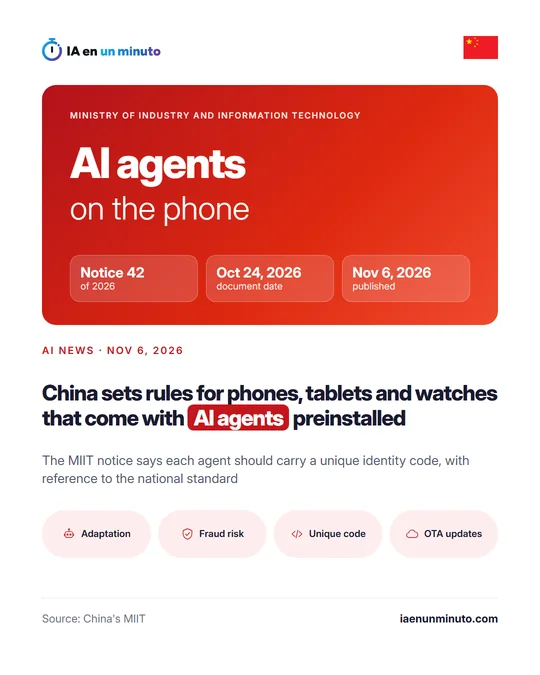
China wants every AI agent that comes built into a phone, tablet or watch to have its own identity code, and the device to pass compatibility and anti-fraud tests before it connects. MIIT, the ministry behind the notice, will have experts review each OTA update before it is officially offered. App stores will also be barred from distributing agents that do not work with that model.
China's Ministry of Industry and Information Technology (MIIT) published a notice on November 6, dated October 24, to tighten network access control for phones, tablets, watches and other devices that ship with a preinstalled AI agent. The text defines an agent as a system able to perceive, remember, decide, interact and carry out tasks on its own.
To get permission to connect to the network, these devices will have to pass a check that the agent is compatible with the handset, plus a fraud risk assessment and an advance test of their ability to fight fraud. Each agent will have to carry a unique identity code, taking as a reference the series of national standards on agent interconnection. Manufacturers will have to make sure the device does not change after it receives its licence and report any major change to the ministry.
If a manufacturer wants to update over the internet (OTA) the agents on devices already in use, it will first have to submit a plan to the ministry covering the timing, the scale, the users affected and the security and anti-fraud measures. Once the update is finished it must hand in a report, and only after the ministry has put it through an expert evaluation and a consultation can the service be officially offered to users.
Agent developers will have to show in the settings the list of device models and operating systems on which they have been checked to work. App stores will not be allowed to offer agents for incompatible models, and app developers will have to state with an electronic signature whether they agree to an agent using their app; without that statement, the agent cannot force its way into it. Stores will be able to demand fixes within a deadline or remove agents that have not passed the check.
A ministry official, quoted by the Xinhua news agency in its report, argues that the notice gives equal weight to encouraging innovation and to safety. The notice sets no deadlines.
Why it matters · analysis and opinion
China is not waiting for AI agents to spread before regulating them: it wants the phone that ships with them to go through the same filter as any telecoms equipment before it goes on sale. The rule spreads responsibility across three players at once: the handset maker, whoever develops the agent and the app store, which becomes answerable for what it distributes. The identity code aims to make it possible to know which agent is acting in each case. What users may notice most is the pace of improvements: every change to an agent already installed will have to wait for a ministry review before it is officially offered. Since the text gives no dates, it remains to be seen when it will apply and what will happen to models already on sale.
Official source: China's MIIT · Written with the help of AI: how we make the news