A Science investigation reveals that several EEG headband makers use their customers' brain data to train AI
IA en un minuto newsroom · Editor: Jon Elgezabal
In 30 seconds
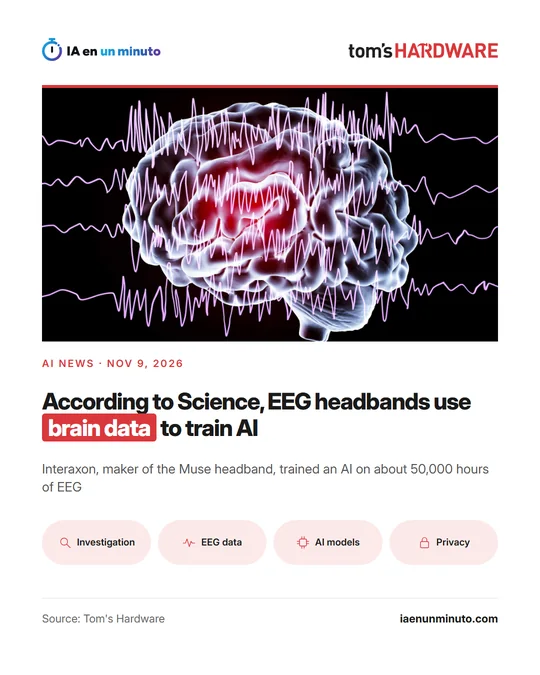
Science and the Pulitzer Center found that several EEG headband brands reuse their customers' brain recordings to build AI, without saying so at first. Interaxon, owner of Muse, used about 50,000 hours of EEG to train a model and, like Emotiv, revised its policy after the journal's questions. Science adds that over two thirds of those companies can hand over data in a sale without asking the user.
Some headbands that track sleep record the electrical activity in the wearer's brain, and those recordings are also being used to train artificial intelligence. That is the finding of an investigation by the journal Science with the Pulitzer Center's AI Accountability Network, as reported by Tom's Hardware.
The consumer neurotechnology companies examined hold tens of millions of hours of electroencephalograms (EEG, a record of the brain's electrical activity). Several are using them to develop brain foundation models: AI that picks up the patterns that repeat in that activity and can later be tuned to identify various brain states or to support research work. They did so without explaining it in their privacy policies at first.
One of them is Interaxon, the Canadian company that makes Muse, a headband for sleep and meditation. It has already trained a model on about 50,000 hours of recordings and says it first strips out the details that identify the user, such as name, email or home address. Until it spoke with Science, its privacy policy did not state explicitly that the recordings could be used to train this kind of model; it has since updated it.
Emotiv, another EEG headband maker, uses recordings from buyers of its high-end devices as part of the training material for its Large Brain model. It also changed its policy after questions from Science: it now states that it uses de-identified neural data to train models, provided the user explicitly agrees.
According to Science, over two thirds of the firms examined keep the option of transferring data in corporate deals without the user's consent, so a small neurotechnology company that gets sold could see its recordings pass to the buyer. Colorado and California have changed their laws so that neural data is protected; other US states have yet to follow.
Tom's Hardware notes that these headbands do not read thoughts: most use between one and six electrodes, compared with the 19 to 25 of clinical equipment, and their recordings are less complete.
Why it matters · analysis and opinion
Brain recordings are not just another piece of data: they can be used to recognize different brain states, and a policy change made after the fact does not protect people who had already handed over their recordings. The case shows how a wellness gadget can become a source of AI training data without the user noticing, and how a clause on corporate transactions can move those records to a new owner. For now, only some US states treat neural information as a category that needs protecting. Anyone using one of these headbands should read the current policy, check whether model training depends on explicit consent and weigh whether it is worth continuing to sync their recordings.
Source: Tom's Hardware · Written with the help of AI: how we make the news