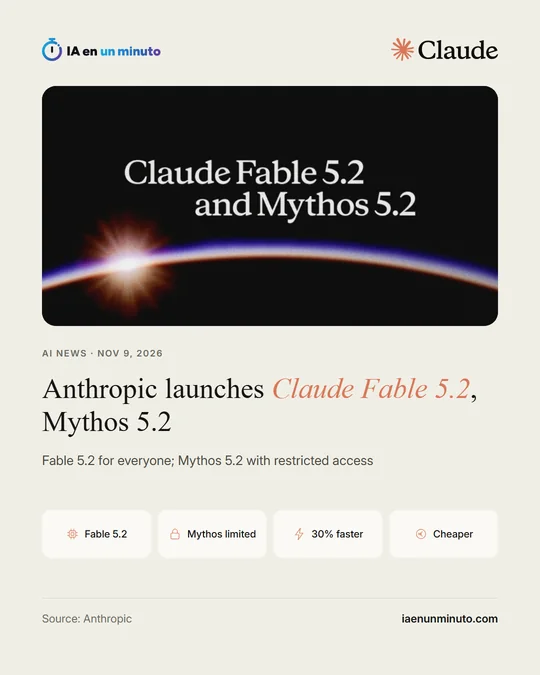
Anthropic launches Claude Fable 5.2 for everyone and reserves Claude Mythos 5.2 for verified organizations
IA en un minuto newsroom · Editor: Jon Elgezabal
In 30 seconds
Fable 5.2 and Mythos 5.2 are one model: the first, with cybersecurity and biology filters, is open to everyone, while the second requires passing Anthropic's verification. Anthropic promises up to 30% more speed than the 5.1 generation, at $8 per million tokens going in and $40 per million coming out. Mythos also reaches Claude Security, the Claude Enterprise tool that searches code for vulnerabilities.
Anthropic has introduced Claude Fable 5.2 and Claude Mythos 5.2, the new version of the two models the company devotes to the hardest technical problems. Under the hood they are one and the same model; what differs is who can use each of them.
Fable carries cybersecurity and biology safeguards to prevent misuse, which is why it is open to all users: it already runs on every platform, with Amazon Web Services, Google Cloud and Microsoft Azure among them. Mythos is kept for cybersecurity or biomedical research organizations that request it through Anthropic's verification programs. Claude Enterprise customers can also use it, without joining those programs, inside Claude Security, the company's service that reviews code in search of vulnerabilities.
According to Anthropic, both respond up to 30% faster than the 5.1 versions and are cheaper: $8 for every million tokens of input and $40 for every million of output. There is also an optional fast mode, which makes generation as much as 2.5 times quicker and costs $16 and $80 respectively. For Mythos, that mode is only open to verified organizations.
In tests before the launch, again according to the company, 1,000 Fable 5.2 agents working as a team took 30 hours to formalize the proof of Fermat's Last Theorem, converting it into a form that software can verify one step at a time. Anthropic's first formalization, carried out with a research version of Claude, had needed 11 days. The model also cracked two open problems in black hole physics, and the company is publishing those results as preprints.
Anthropic still advises Claude Opus 5.5 for most everyday programming and knowledge work, keeping Fable or Mythos for the most ambitious technical jobs. This week, subscribers on paid plans that include Fable are getting extra use of the model.
Why it matters · analysis and opinion
The split between Fable and Mythos means the difference between the products lies not in what the model can do, but in who can ask it to: the most sensitive cybersecurity or biology tasks are only unlocked after a verification. It is a way to sell a very capable model without leaving its riskiest uses open. For those building on the API, the price cut and the extra speed change the numbers on projects that used to be too expensive. Even so, Anthropic itself advises starting with Opus for daily work and keeping Fable for the most complex jobs. Before moving whole workloads, it is worth testing it on the team's real tasks, because the lab demonstrations the company showcases do not say how it will perform in each case.
Official source: Anthropic · Written with the help of AI: how we make the news
What does it mean for your business? · analysis and opinion
This affects small businesses, freelancers, and development teams in Spain and Latin America that already work with Claude or pay for its use by tokens. We think that for those who use AI mainly to draft emails, summarize documents, or prepare presentations, the change matters little: Anthropic itself recommends starting most coding and knowledge tasks with Claude Opus 5.5, its model for daily use, and moving up to Fable only for the most ambitious and open-ended technical work. Mythos is out of reach for almost all small businesses, because it is reserved for cybersecurity or biomedical research organizations that pass its verification programs.
Our advice is not to switch the default model overnight. The sensible approach is to pick two or three real tasks that are getting stuck today, test them with Fable 5.2 and with Opus 5.5, and compare the result and the cost before deciding. It is worth reviewing token consumption during the first few weeks.
Cost is the point to watch: $8 per million input tokens and $40 per million output tokens, and the optional fast mode raises that to $16 and $80. Even though it costs less than the 5.1 versions, a long task can consume many tokens, so we would turn on fast mode only when the speed is worth paying twice as much.