Google introduces the Gemini Decisions API and its Gemini Decision 1 model to choose between options in milliseconds
IA en un minuto newsroom · Editor: Jon Elgezabal
In 30 seconds
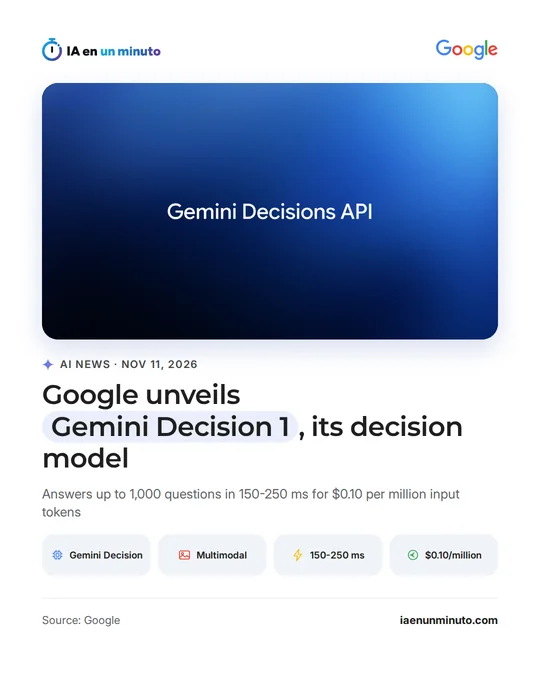
Gemini Decision 1, Google's new model, does not write: it scores the options and says which one fits best, with a confidence level between 0 and 1. Google says a single request can handle as many as 1,000 closed questions about a single text, image, audio, video or PDF file, in 150 to 250 milliseconds. Google AI Studio already offers it for $0.10 per million tokens received and nothing for the answer.
Google has presented a model that does not write answers: it picks between options. It is called Gemini Decision 1 and it works through the new Gemini Decisions API, an interface built for closed decisions, such as choosing which tool to use, checking whether a piece of content meets a rule or deciding which model a query should go to.
It takes an input of up to 256,000 tokens that can mix text, images, audio, video and PDF, and over that input it answers up to 1,000 questions at once. There are three kinds: yes or no; multiple choice, with between 2 and 255 options; and scoring against an ordered rubric. Each answer comes with a confidence score from 0 to 1, so that unclear cases can be passed to another system or to a person.
Rather than producing text word by word, the model rates the options in a single pass. Google cites an end-to-end latency of 150 to 250 milliseconds and a price of $0.10 per million input tokens, with nothing charged for the output; the shared input is billed once per request, however many questions are asked. According to Google's own tests, it comes out almost five times cheaper than Gemini 3.5 Flash-Lite on the same set of tasks.
It is already available on Google AI Studio, Google's platform for developers, with a free tier for prototypes, and it will soon reach Gemini in Google Cloud. Teams at Google are already using it: Gemini Notebook, for example, relies on it to send each query to the right model, with up to 40% lower latency on everyday questions.
Why it matters · analysis and opinion
Until now, getting an application to make a simple decision with AI, such as sorting a query or checking whether a photo meets a rule, meant one of two paths: training a custom classifier or asking a generative model, which is slower and more expensive. Google opens a third way with a model that only chooses, fast and cheap precisely in the small tasks an agent repeats thousands of times. That its own teams already use it to distribute queries suggests it is not an isolated experiment. It remains to be seen how it performs outside Google's own tests. For anyone already building AI workflows, it is worth trying on a narrow decision and comparing it with what they use today.
Official source: Google · Written with the help of AI: how we make the news