Google launches A2UI 1.0, its open protocol for AI agents to respond with interactive screens
IA en un minuto newsroom · Editor: Jon Elgezabal
In 30 seconds
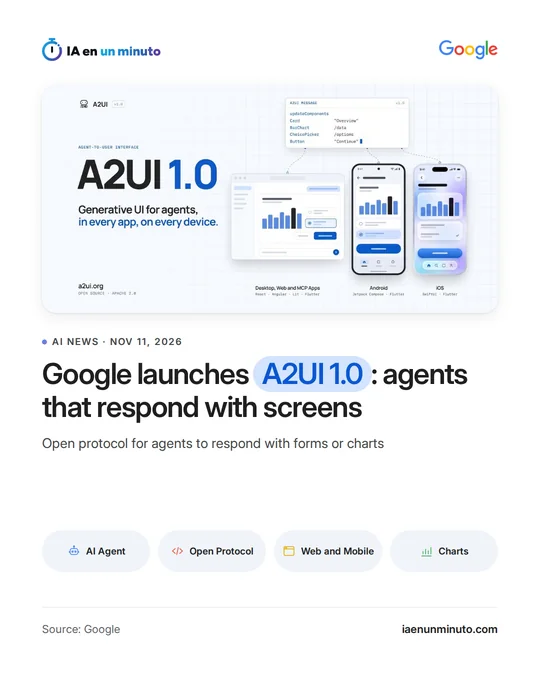
A2UI 1.0, Google's open protocol, lets an agent answer with forms, charts or buttons instead of blocks of text. Android will get its stable version later, while the web, Flutter and iOS already have libraries that paint those screens with each app's native pieces. Atlassian is adding it to Jira so agents can ask for missing details with cards, and Claude and Gemini can display those screens.
Google has released A2UI 1.0, the first stable version of its open protocol for generative interfaces. It allows an AI agent to reply not just with text but with interactive screens: a form waiting for confirmation, a chart or a card for choosing between options. Google makes its case with an example: comparing three products or reviewing a detailed plan from a wall of text is awkward.
The split of work sits at the core of the protocol. The agent describes what should be displayed and each application renders it with its own native components, so the brand's design is respected and, according to Google, sensitive data is bound on the server without going through the model. Version 1.0 adds two-way function calls, so that a flight picker, for instance, can confirm what is free right away, along with accessibility support.
It is usable now with open-source libraries that draw these screens on the web (React, Angular and Lit), in Flutter and on iOS (SwiftUI); the Android one (Jetpack Compose) is still on version 0.9.1, with 1.0 due soon. On the agent side there are kits for Python, TypeScript and Dart. The screens can also show up inside assistants that support MCP Apps, such as Claude and Gemini.
Atlassian, Alation, Bloomberg and ByteDance are already working with it. Atlassian is bringing it to Jira, where teams can hand tasks to agents: when one is missing a detail or a decision, it asks through an interactive card inside the task itself. In June, ByteDance released a renderer for Lynx, its cross-platform framework, which currently supports version 0.9. Gemini, for its part, supports 0.9.1 today.
Why it matters · analysis and opinion
Without a common format, anyone who wanted their agent to show more than text had to solve it on their own in each application. An open, stable protocol changes that calculation: the same agent can appear on the web, on mobile or inside Claude and Gemini without rebuilding the interface for each place. Opening it to competing assistants suggests Google wants it to become the standard before someone else's does. What is missing for real use lies in the details: Android still lacks the stable version and Gemini remains on the previous one. Comparing products or approving a plan with buttons is easier than reading paragraphs, so for a team already building agents it makes sense to try it on a narrow case, such as a confirmation, before redesigning anything.
Official source: Google · Written with the help of AI: how we make the news