Anthropic launches a self-hosted version of Managed Agents in private beta, which customers run on their own infrastructure
IA en un minuto newsroom · Editor: Jon Elgezabal
In 30 seconds
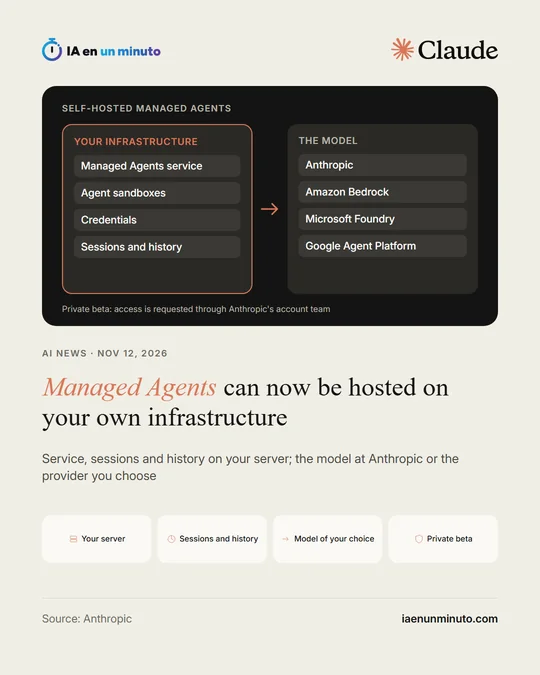
Managed Agents, the Anthropic APIs for putting together agents with Claude, can now be installed in full inside each company's infrastructure, in private beta. The customer hosts the agent's coordination, the sandboxes, the history and the credentials, and picks where model requests go. Each environment accepts a closed list of hosts and keeps a log of every step.
Anthropic has announced a self-hosted version of Managed Agents, its set of APIs for building and deploying autonomous agents with Claude, now in private beta.
With it, all the pieces of the service sit in the customer's own cloud or on its own servers: the environment that coordinates the agent (what Anthropic calls the harness), the sandboxes where the agent's code is executed, the credentials and the session history. The company runs the Managed Agents server, its database and the machines on which agents use the terminal and files. Calls to the model can be sent to Anthropic, to a cloud provider (Amazon Bedrock, Microsoft Foundry or Google's Agent Platform) or to a gateway the company runs itself, and developers keep working with the same APIs as in the hosted service.
Managed Agents started out as a hosted service on the Claude Platform, with Anthropic in charge of the infrastructure, and later accepted self-hosted sandboxes for teams whose code could not leave their environment. Until now, anyone who wanted the whole service in-house had to put that platform together on their own.
Anthropic mentions tasks such as repairing broken builds, checking new releases or sorting alerts, carried out by agents that work on code without supervision and need to reach internal systems. For those cases, each environment can be restricted to a list of permitted hosts, with everything else blocked; credentials stay outside the sandbox and can be kept in the company's own secrets manager; and every step the agent takes is logged, in a record that can be exported via OpenTelemetry. If a company already has a zero data retention agreement with Anthropic, it covers the requests these agents send in the same way.
Access is requested through Anthropic's account team.
Why it matters · analysis and opinion
For banks, insurers or any company with data that cannot leave the building, the obstacle to letting an agent work on its own is usually not the model but where its activity ends up: which credentials it uses, what sessions it leaves behind and which route its requests take. This version addresses that objection without forcing anyone to build the platform from scratch, and it also lets them choose the model provider. In return, the company takes on the upkeep of the server, the database and the machines, and the security of the history becomes its responsibility. That it is a private beta, with access through the account team, suggests it is aimed at large customers for now. The precautions Anthropic describes, such as limiting hosts and reviewing the log, also apply to anyone using the hosted service.
Official source: Anthropic · Written with the help of AI: how we make the news
What does it mean for your business? · analysis and opinion
This private beta is not meant for the small business that uses Claude from the chat. It is aimed at technical teams that already build agents with Anthropic's APIs and that have an account team with the company, which is who you ask for access. For a small business or a freelancer in Spain or Latin America without that profile, nothing changes for now. In addition, running the service in house means operating a server, its database and the machines where the agents work, maintenance that should not be underestimated.
What does help any company that already lets an agent touch its code or its internal systems are the precautions that Anthropic describes, which also apply to its hosted service. Our advice: limit each agent to a short list of allowed hosts (in the company's example, only the git server and the package registry), keep passwords and keys out of the space where its code runs, and review the record of every step it takes.
The prudent approach is to start with narrow tasks and no access to customer data. If the company already has zero data retention agreed with Anthropic, the company states that it applies in the same way to the requests these agents send to Claude. Session history, however, is stored in the company's own database, and protecting it becomes the company's responsibility.