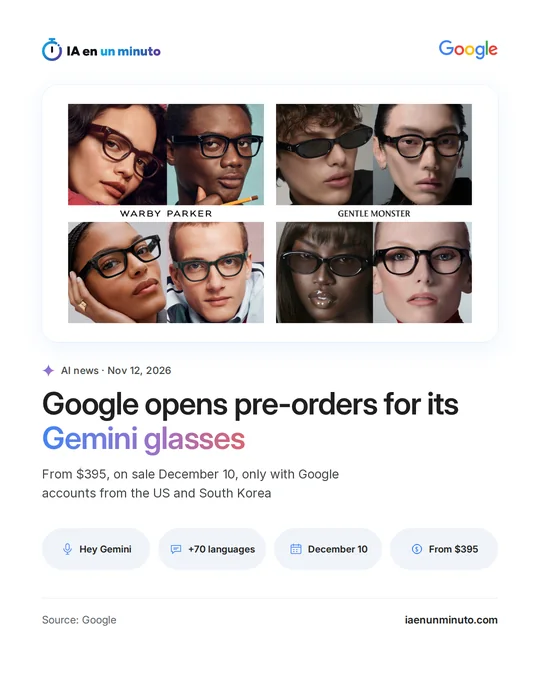
Google opens pre-orders for its Gemini smart glasses, which go on sale December 10 starting at $395
IA en un minuto newsroom · Editor: Jon Elgezabal
In 30 seconds
Google's Gemini glasses, made with Warby Parker, Gentle Monster and Samsung, can now be pre-ordered: they start at $395 and reach stores on December 10. They only work with Google accounts from South Korea and the United States. Gemini answers by voice about what the wearer is looking at, gives spoken Google Maps directions and translates in more than 70 languages.
Google is now taking pre-orders for its intelligent eyewear with Gemini, its AI assistant, built into the frames.
The collections, designed together with eyewear brands Warby Parker and Gentle Monster and with Samsung, go on sale in stores and online on December 10. Warby Parker's line, with three styles, starts at $395; Gentle Monster's, with six designs, starts at $449 and will be sold in the United States and South Korea. Most frames can take prescription lenses.
According to Google's fine print, the glasses can only be used with Google accounts from those two countries, and they require an account for users aged 18 or over. They weigh about 41 grams, last up to nine hours on a charge, carry a 12-megapixel camera and work with Pixel phones (from the Pixel 7 series), Samsung phones and iPhones (from the iPhone 13 Pro).
Saying "Hey Gemini" or tapping the frames is enough to ask about whatever is in front of the wearer, check the calendar, hear Google Maps directions in the ear or translate conversations in real time in more than 70 languages.
The glasses also include Guided Vision, a Gemini feature that describes what is in front of the wearer aloud, in conversation, for blind and low-vision users, for instance to read small print or locate everyday objects. Google's notes say that at launch it only works with a compatible Android phone.
Each pair comes with a portable charging case that can top the glasses up as many as seven times. On privacy, Google says what the camera sees for Gemini is not stored in the Gemini history or used to train AI models or target ads, and that a light alerts people nearby when a photo or video is being taken.
Why it matters · analysis and opinion
Google's bet is that AI glasses should look like ordinary glasses: frames from fashion brands, with or without prescription lenses, and an assistant controlled by voice. The account restriction leaves users in Spain and Latin America out for now, even if they get hold of the glasses some other way. The other front is the trust of the people nearby: Google responds with a light that warns when it is recording and with a commitment not to store or train on what the camera sees, but whether people accept wearing a camera on their face will be decided on the street. It remains to be seen when they will reach more countries and whether the price, that of designer glasses, persuades people who do not need them to see.
Official source: Google · Written with the help of AI: how we make the news