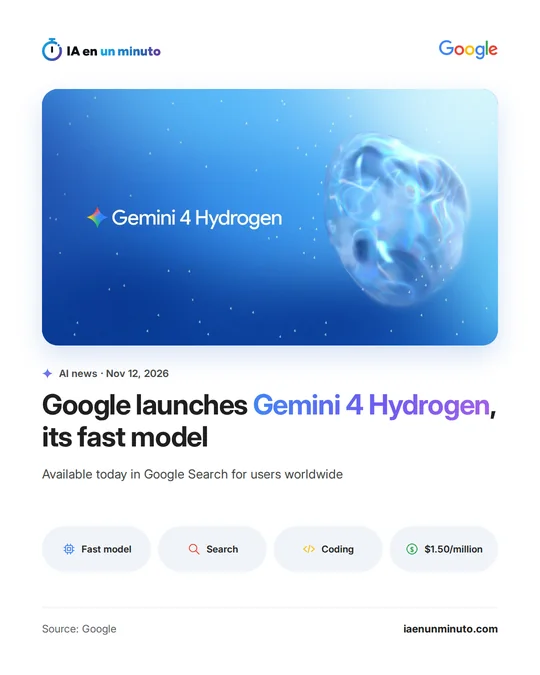
Google launches Gemini 4 Hydrogen, its fast model from the Gemini 4 family, in Search, the app and the API
IA en un minuto newsroom · Editor: Jon Elgezabal
In 30 seconds
Gemini 4 Hydrogen is the fast model from Google DeepMind for coding and running agents, and according to the company it scores above Argon on the Artificial Analysis index. From today it arrives in Search and the Gemini app, as well as in Google AI Studio and through the API. Google charges $1.50 for each million tokens it takes in and $7.50 for each million it produces.
Google is adding a fast model to its Gemini 4 family and bringing it to Search on the same day.
Google DeepMind has introduced Gemini 4 Hydrogen, designed for coding and agent work with speed and efficiency. It joins Gemini 4 Carbon and Gemini 4 Argon, the family's most advanced models, which the company positions for long, difficult reasoning. According to Google, at its default reasoning level (high, out of four) it beats Argon on the Artificial Analysis Intelligence Index, 51 to 50, and reaches 54 at the top level. For anyone coming from Gemini 3.8 Flash, the company says it finishes tasks 2.5 times faster and makes more than five times fewer fabricated claims.
From today it is reaching users worldwide: Google Search for everyone, the Gemini app, the Gemini API and Google AI Studio (the platform for developers), as well as Gemini for business and, for paid Google AI Pro and Ultra subscribers, Google Antigravity. It costs $1.50 for every million input tokens and $7.50 for every million output tokens, at the same price across its full context window of one million tokens.
On its Search blog, Google calls it "the biggest model upgrade to Search yet": it says it better understands questions with several parts, links to more sites and shows more tables and images. All the performance figures come from Google itself.
Why it matters · analysis and opinion
What matters is not only the model but where it lands: by going into Search for everyone, Hydrogen starts to shape the answers that many people see every day and which websites get visits from them. For developers, the pitch is to split the work, with the most advanced models for deep thinking and a nimble, cheaper one for everyday tasks. That a model from the fast range beats one of the company's most advanced models on an external index shows how quickly these capabilities are getting cheaper. It still has to be seen outside Google's tests: the speed and reliability figures are its own, and it is worth checking them against real tasks before switching models.
Official source: Google · Written with the help of AI: how we make the news
What does it mean for your business? · analysis and opinion
This mainly affects two profiles in Spain and Latin America. The first is anyone already using the Gemini API or Google AI Studio to automate tasks, such as small agencies, freelance developers or companies with their own assistant: the new model costs $1.50 per million input tokens and $7.50 per million output tokens, with the same price across its entire context window of one million tokens. For those coming from Gemini 3.8 Flash, Google presents it as a faster option with far fewer fabricated claims. For those who only open the Gemini app occasionally, little changes.
The second profile is any business that depends on being found on Google. Search now includes the model for all users and, according to Google, it runs simultaneous queries on each part of the question, links to more sites than before, and shows more comparison tables and images. Our advice is to check these days whether your own website appears in those responses for your sector's key searches, and to make sure product or service pages answer specific questions clearly.
To test the model in a real workflow, it is wise to start with a limited task, compare results and cost for a few days against the model you already use, and monitor token consumption before moving it into production. The performance figures come from Google, so it is worth checking them against your own data.