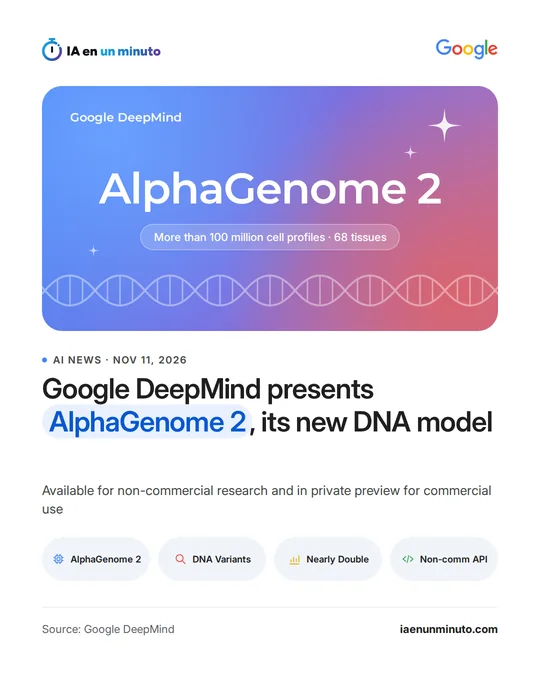
Google DeepMind presents AlphaGenome 2, its model that predicts how DNA variants affect specific human cell types
IA en un minuto newsroom · Editor: Jon Elgezabal
In 30 seconds
AlphaGenome 2, from Google DeepMind, estimates how DNA variants act in specific cells, such as cardiac or immune ones, instead of in the tissue averages its predecessor relied on. DeepMind says it detects nearly twice as many variants with an effect on how genes behave. Starting today, researchers doing non-commercial work can reach it through the API, while companies get access in a private preview.
Google DeepMind has unveiled AlphaGenome 2, the new generation of its model for estimating how DNA and its variants influence particular types of human cells. The company presents it as a tool to help scientists find out which cells lie behind a disease.
The first AlphaGenome, released last year, worked out the effect of variants on molecular activity using averages for entire tissues. It was followed by AlphaGenome Atlas, a platform with predictions for each of the 9 billion possible one-letter changes in the human genome. Version 2 goes down to concrete cell types and states, such as heart muscle cells or immune cells fighting an infection.
To get there, DeepMind rebuilt the architecture. The earlier model predicted thousands of experiments from many tissues at once, starting from a stretch of one million DNA letters; the new one handles a single condition at a time (a tissue, a cell type or a state), which it receives together with the sequence. Its training drew on over 100 million profiles of single cells from 68 tissues, with samples from people and mice, and it adds DNA methylation to what it already covered, such as gene expression or chromatin accessibility.
According to DeepMind, it spots nearly twice as many variants that alter gene expression as its best previous model. On TenK10K, a large map of 28 immune cell types, it found 30% of the causal variants, compared with 16% for the original AlphaGenome adjusted with single-cell data and for other specialized tools. It can also analyze new experiments without being retrained: uploading gene activity data from a few dozen cells is enough.
Starting today, it can be used for non-commercial research through the AlphaGenome API, with tutorials in Colab, and in a private preview for commercial research. DeepMind also says that AlphaGenome 2 "Skills" will soon reach Google Antigravity, its development platform built around agents. The company stresses that both AlphaGenome and AlphaGenome 2 are for research only: neither has been validated or approved to diagnose patients or for clinical use. The announcement gives no prices and no date for general commercial access.
Why it matters · analysis and opinion
Genetic studies point to stretches of DNA linked to a disease, but they do not always make clear which specific variant causes it or in which cells it acts. A model that proposes that answer on a computer does not replace the lab, although it can help decide which experiments to run first. For now, the advance stays within research: DeepMind makes clear that it is not meant for diagnosis, and reaching the doctor's office would take clinical validation that nobody has announced. For research groups, the sensible step is to try it on their own data and check its predictions against what they already know about a gene or a disease before trusting them. Companies, for their part, depend for now on the private preview.
Official source: Google DeepMind · Written with the help of AI: how we make the news