Thousands of apps built with Grok Build, Elon Musk's coding agent, were left exposed with confidential information
IA en un minuto newsroom · Editor: Jon Elgezabal
In 30 seconds
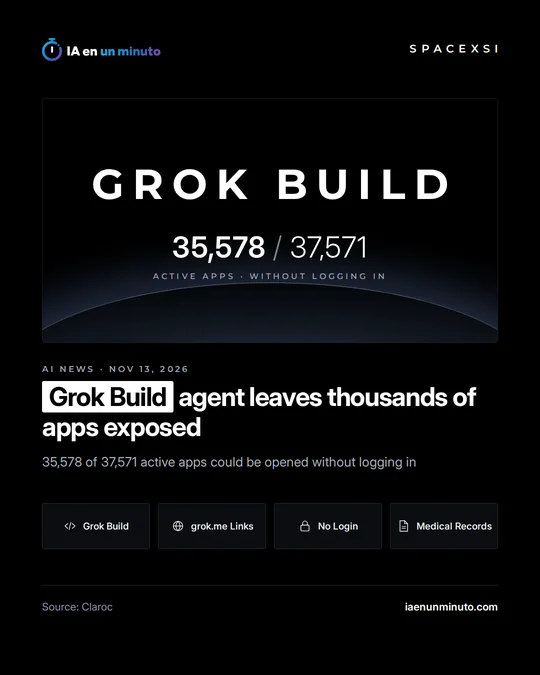
Claroc found that 35,578 of the 37,571 active Grok Build apps could be reached without an account, including medical records and a hospital's staff list. The flaw came from the grok.me addresses: meant to be impossible to guess, they ended up collected by public passive DNS services. SpaceXSI says an app is only visible once its author publishes it, though Claroc found the open option already switched on in its tests.
Claroc, a cybersecurity company, has discovered that thousands of apps made with Grok Build, Elon Musk's coding agent, could be opened with no checks at all. As 20Minutos explains, drawing on TechRadar, Claroc gathered 43,601 addresses. Of the 37,571 that were still running, 35,578 could be viewed without signing in.
Many were simple tools, but others held private data: medical records, a roster of more than 3,500 employees at a hospital and a time-tracking sheet with 18 accounts and their passwords. There were also 24 apps put together by staff at SpaceXSI, the company formed by merging SpaceX and xAI, and at X, carrying internal documents such as plans for bringing in new sales staff and advertising proposals. According to 20Minutos, one of them was labeled confidential and addressed to a US federal agency.
The flaw lies in the way they are shared. Each app gets an address with several randomly chosen words in front of grok.me, so that nobody can guess it. Yet those addresses end up in public passive DNS databases, services that store the names of the websites people look up, and from there they can be pulled out in bulk.
SpaceXSI maintains that an app stays private until its author decides to publish it, and that doing so takes several steps with warnings along the way. Claroc replies that, on the account it used for its tests, the "Anyone with the link" option was already ticked when publishing.
Claroc alerted the company on November 8 and, when it got no reply, also raised the matter on X by tagging Musk, according to the Ars Technica article republished by Winzheng. That outlet reports that SpaceXSI began taking down the links to its 24 apps a few hours after receiving its questions, and that almost everything else that had been exposed was still reachable when it went to press. Claroc, for its part, has started warning other organizations whose data may have been left in the open.
Why it matters · analysis and opinion
The case shows a risk that grows with tools that turn an idea into an app in minutes: the people using them rarely stop to check who can see the result. A link that is hard to guess is not the same as a locked door, especially when domain names end up in public databases that anyone can search. For a company, the practical step now is to take stock of what staff have built with these agents, check how each one was shared and pull anything holding customer, patient or employee data. It is also worth demanding that platforms make private the starting option, not a step people have to remember. That SpaceXSI itself had internal material on view suggests the problem lies not with careless users but with the design.
Source: 20Minutos · Written with the help of AI: how we make the news
What does it mean for your business? · analysis and opinion
This affects freelancers and small businesses in Spain and Latin America that use Grok Build, or any other agent that builds and publishes apps from a description, to set up internal tools: client lists, patient records, shift schedules or time-tracking sheets. Those who do not publish anything with these agents do not face this specific risk, but the case teaches a lesson that applies to any similar tool: a link with random words is not a secret link, because it can end up in public records that anyone can check.
Our advice is to spend a few minutes reviewing each published app and checking who has access. If the "Anyone with the link" option appears selected and the app does not need to be public, the sensible move is to take it down or leave it unpublished. The prudent approach is to delete test apps that are no longer used, avoid storing passwords inside them (one of the time-tracking sheets found had 18 accounts with their passwords) and change any password that has sat in an open app.
Checking this costs nothing; not doing it is what is expensive. Health data has special protection under European rules, and staff details are personal data too. If an outside party has been able to see them, the company may have to treat it as a security breach, notify the data protection authority and, depending on the case, the people affected.