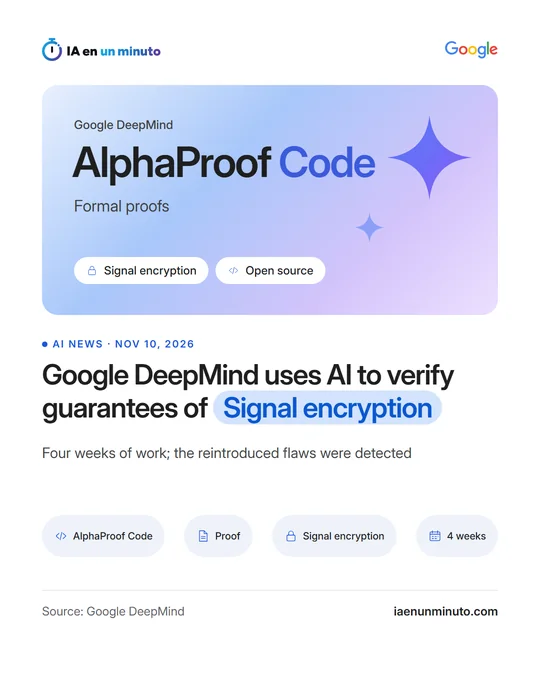
Google DeepMind uses AI to mathematically prove key guarantees of Signal's encryption in a proof of concept
IA en un minuto newsroom · Editor: Jon Elgezabal
In 30 seconds
AlphaProof Code divides the job between people who pick what to prove, AI agents that draft the proofs and Lean, which reviews them unaided. DeepMind kept it at work for four weeks on the cryptographic core of Signal, the same one Google Messages relies on. Signal had long since fixed two flaws that the team slipped back into a copy, and the system showed that this version was not safe.
Google DeepMind has unveiled AlphaProof Code, a system of several AI agents for formal verification, that is, for showing mathematically that a program does what it is expected to do. The work is split like this: human experts decide what has to be proven, the AI agents put the proofs together, and Lean, a checking program, confirms them automatically.
The company has used it on the central cryptographic code of Signal, the technology that keeps billions of private conversations safe in apps such as Signal and Google Messages. The aim was to prove security properties such as messages staying protected before and after a device is temporarily compromised, and to do so on the code that runs on devices, not just on the design of the protocol. According to DeepMind, the agents, built on Gemini Carbon, produced more than six million lines of Lean and flagged barely 1% of the code for a second human review. The process took four weeks.
To test the system, the team put two real, already-fixed flaws back into an isolated version of the code, and in both cases AlphaProof Code produced a machine-checked proof that this version was insecure. According to Infobae, citing Wired, the researchers call it a proof of concept: they found no new vulnerabilities, and the analysis covered certain guarantees of the protocol rather than the whole Signal mobile app. Google has not said what the work cost or whether it is preparing a commercial product.
DeepMind will release the formal verification artifacts as open source.
Why it matters · analysis and opinion
Formal verification has for years been kept for small pieces of software and highly specialised teams, because writing each proof by hand was painfully slow. If agents do the heavy lifting and leave people only the decisions and the review of doubtful parts, the cost may fall enough to think about other critical programs. What is still unknown is exactly what will decide whether it leaves the lab: how much it costs, whether it works as well with code less documented than Signal's, and who will offer it as a service. Anyone who relies on sensitive software has nothing to buy today, but does have a good reason to ask suppliers which parts of their code are proven and which are only tested.
Official source: Google DeepMind · Written with the help of AI: how we make the news