IA en un minutoNewsBusiness and products
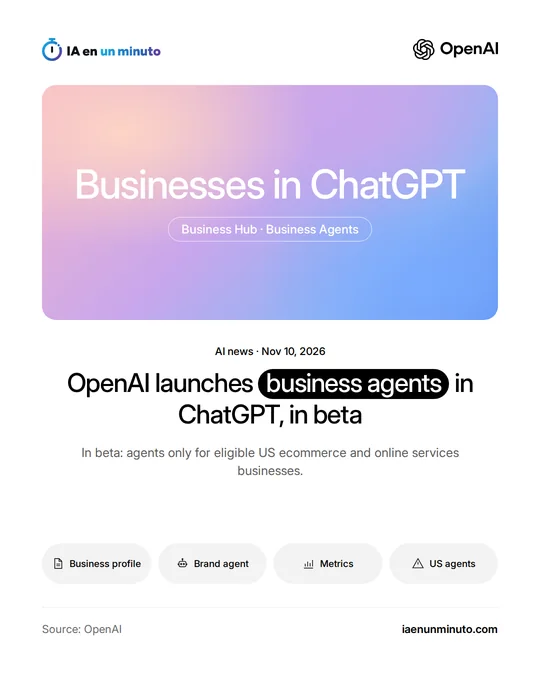
OpenAI launches Businesses in ChatGPT in beta: verified profiles and business agents inside the chat
IA en un minuto newsroom · Editor: Jon Elgezabal
In 30 seconds
OpenAI is opening Businesses in ChatGPT in beta, letting companies claim and verify their profile inside the assistant from Business Hub. Business Agents, the agents a brand uses to answer questions about its products, are limited for now to eligible online businesses based in the United States. OpenAI says companies will not see the chats, only aggregated counts of mentions and clicks.
OpenAI has unveiled Businesses in ChatGPT in beta, a set of tools that gives companies a presence of their own inside its assistant, which the company says 1.2 billion people use every week.
The foundation is Business Hub, the panel where an eligible company, in any country where ChatGPT is offered, can claim its listing and, once verified, keep its details current. Stores can also upload product catalogs with prices and availability. Shopify sellers can link their store from the panel itself or from the Shopify admin, while Enterprise customers and advertisers go through their OpenAI contact. According to Unite.AI, which cites OpenAI's FAQ, only companies with a website can claim a profile at first, and a claimed profile carries a blue mark that does not guarantee a better position or more sales.
The second piece is Business Agents: agents that a company builds, tests and publishes to field questions about what it sells, such as how two products differ. When a business shows up in an answer, the user can open its profile and, if it has an agent, start a separate conversation with it, labeled and kept apart from ChatGPT's own answers. For now they are only offered to eligible ecommerce and online services businesses in the United States.
OpenAI states that it does not pass users' conversations or agent chats on to businesses. What they get instead are aggregated metrics, such as the number of mentions and of clicks to their website and the topics of conversations in which their site is cited, and only once there are enough interactions. Businesses will also be able to sponsor their agent and make it the landing point for ChatGPT Ads, ChatGPT's advertising, with that advertising marked as such. The company says it will gradually bring these tools to more markets and types of business, without giving dates.
Why it matters · analysis and opinion
ChatGPT is starting to work like a shop window with its own rules, much like business listings once became in search engines: a company that does not claim its own leaves the assistant to talk about it using only whatever it finds. The delicate part is trust. Mixing independent answers, brand agents and ads on the same screen means users must always be able to tell who is talking to them, and OpenAI knows it, which is why it insists on labels and separation. It remains to be seen how these agents behave when someone asks about a competitor or a flaw, and when they will reach beyond the United States.
Official source: OpenAI · Written with the help of AI: how we make the news
What does it mean for your business? · analysis and opinion
For an online store or a service business in Spain or Latin America, what matters in the short term is the profile, not the agent. An eligible business with a website, located where ChatGPT is available, can start the claiming process from Business Hub, while Business Agents remain, for now, limited to ecommerce and online services in the United States. OpenAI says it will expand markets and categories, but gives no dates, so it is not worth planning anything around them.
Our advice is to start with something cheap: ask ChatGPT about your own business and about the competition, note which details come out wrong (services, prices, conditions) and fix them first on the website, since that is what the system cites. If Business Hub allows claiming the profile, it is wise to do so and review every detail carefully, because the business is responsible for what it submits and OpenAI does not verify every detail. Stores can consider the product feed, as long as they keep prices and availability up to date.
It is worth not overvaluing the blue check: it shows that the profile is claimed, but it does not guarantee higher placement or more sales, and ChatGPT will keep making independent recommendations and comparisons. The metrics will not be fine-grained either: they are aggregated counts of mentions and clicks that only appear once certain thresholds are passed, so a small business may take time to see useful data. The announcement does not publish prices.